
Got a photo? Identify mushrooms instantly with the Mushby app
Open the appDescription
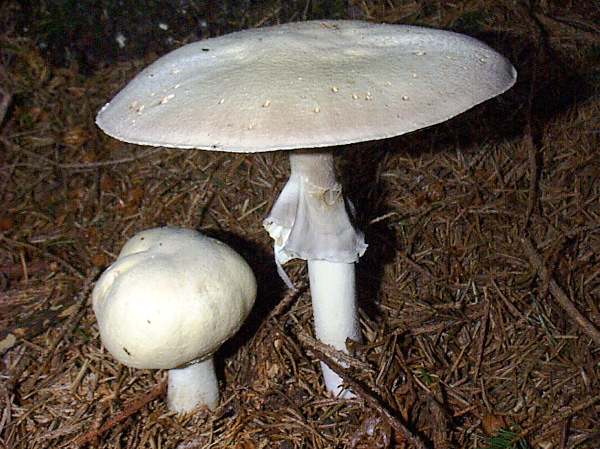
Hebeloma crustuliniforme, commonly known as the Poison Pie or Scaly Wood Mushroom, is a poisonous mushroom that can cause gastrointestinal upset. It is often found in wooded areas and can be mistaken for edible mushrooms, making it a common cause of mushroom poisoning.
How to Identify
- Cap
- The cap is typically 3-8 cm in diameter, convex to flattened, and often has a slightly umbonate (raised) center. The color ranges from pale ochre to tan, and it is often sticky or slimy when moist. The margin may have veil fragments when young.
- Gills
- The gills are adnate (attached to the stem) and crowded. They are initially pale, but become clay-brown as the spores mature. The gills may exude droplets of liquid in moist conditions.
- Stem
- The stem is 4-8 cm long and 0.5-1.5 cm thick, cylindrical, and often has a slightly bulbous base. It is whitish to pale ochre and may have a faint ring zone near the top. The stem surface is often finely hairy or scaly.
- Flesh
- The flesh is whitish to pale ochre and has a radish-like odor and taste.
- Fruiting body
- The fruiting body of Hebeloma crustuliniforme is a typical mushroom shape with a cap and stem.
- Habitat
- Hebeloma crustuliniforme is commonly found in wooded areas, especially under deciduous trees like oak and birch. It fruits from summer to autumn.
Key Facts
- Cap surfaces: Sticky or slimy when moist
- Growth Form: Solitary or in small groups
- Spore Print: Clay-brown
- Body color: Pale ochre to tan
- Odor: Radish-like
- Flesh bruises: No significant bruising
- Height: 4-8 cm
- Cap Diameter: 3-8 cm
- Nutrient gathering: Mycorrhizal
Toxic
Severe ToxicityHebeloma crustuliniforme is poisonous and can cause gastrointestinal upset if ingested.
Quick Check
- Odor: Radish-like
- Fruiting: Summer to Autumn
- Substrate: Wooded areas under deciduous trees
Where to Find
Wooded Areas
Commonly found under deciduous trees like oak and birch.
Europe
Widespread throughout Europe.
Finding Tips
Look for Radish Odor
The distinctive radish-like odor can help distinguish it from edible mushrooms.
Check Gill Color
The clay-brown gills are a key identifying feature.
Similar Species
Edible Field Mushroom
mushroom
Also known as: Agaricus campestris
Scientific Classification
- Phylum
- Basidiomycota
- Class
- Agaricomycetes
- Order
- Agaricales
- Family
- Hymenogastraceae
- Genus
- Hebeloma
Explore Scaly Wood Mushroom
Identify mushrooms anywhere
Free on iOS, Android, and Web. Photo identification, full database, and your personal collection.