
Got a photo? Identify mushrooms instantly with the Mushby app
Open the appDescription
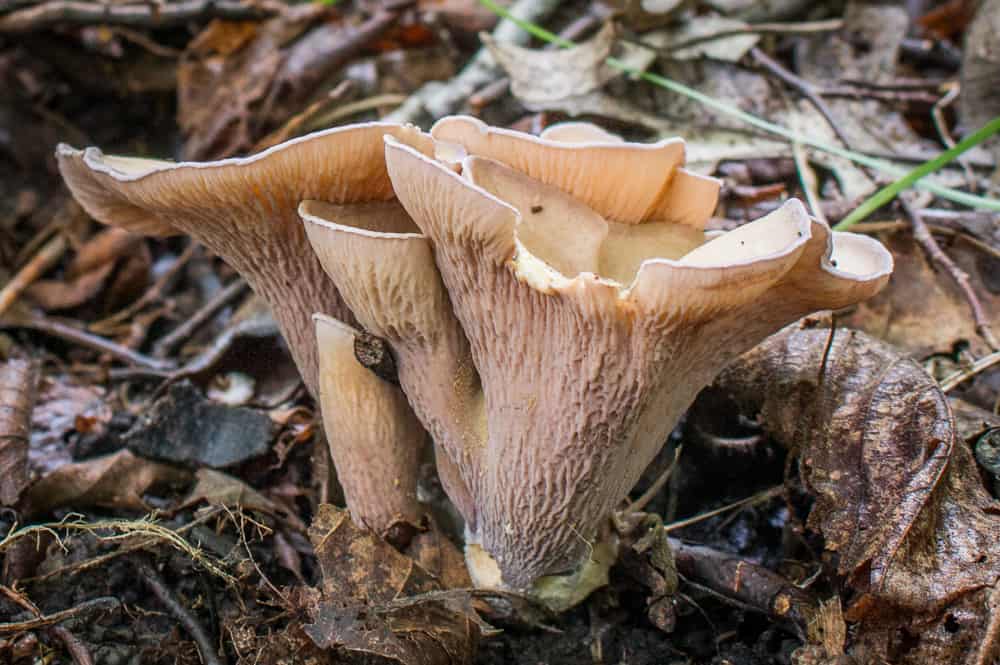
Gomphus clavatus, commonly known as the "Lace Mushroom" or "Violet Cortinarius," is a distinctive and highly sought-after edible fungus. It is characterized by its striking appearance, often resembling a goblet or a hand, with a deeply furrowed or wavy cap margin and downward-sloping, gill-like folds. The fruiting body typically lacks a distinct stem, instead fusing directly into a tapering base. Its color can vary from violet and lavender in younger specimens to ochre and brown as it matures. It is a mycorrhizal fungus, forming symbiotic relationships with coniferous trees.
How to Identify
- Cap
- The cap is eccentrically attached to the stem or absent altogether, forming a distinctive wavy or lobed margin. The surface is typically smooth to slightly wrinkled. The color ranges from violet or lavender when young to ochre, tan, or brownish with age.
- Gills
- Instead of true gills, it possesses distinct, strongly decurrent (running down the stem), blunt, fold-like ridges. These folds are often forked and anastomosing (connecting with each other), creating a maze-like appearance. The color of these folds is typically pale yellowish to ochre or cinnamon.
- Stem
- A distinct stem is usually absent or very reduced, with the fruiting body tapering directly into the substrate. When present, it is short, thick, and concolorous with the cap interior or paler.
- Flesh
- The flesh is firm, brittle, and typically white or off-white. It does not bruise readily. When cut, the flesh is thick and consistent.
- Fruiting body
- A vase-shaped or goblet-shaped fruiting body, often without a distinct stem, tapering downwards. It can be solitary or grow in small groups.
- Habitat
- Found in coniferous forests, particularly under pine, fir, and spruce trees. It prefers well-drained soils and often grows on moss or on the forest floor.
Key Facts
- Cap surfaces: Smooth to slightly wrinkled or uneven margin.
- Growth Form: Vase-shaped, goblet-shaped, or funnel-shaped, often with an absent or greatly reduced stem.
- Spore Print: Ochre to cinnamon brown.
- Body color: Violet, lavender, lilac when young; fading to ochre, tan, or brownish with age.
- Odor: Mild and pleasant, sometimes slightly fruity or earthy.
- Flesh bruises: Does not bruise significantly.
- Height: Typically 5-15 cm (2-6 inches).
- Cap Diameter: 5-20 cm (2-8 inches) across the widest part of the 'cup'.
- Nutrient gathering: Mycorrhizal (symbiotic relationship with tree roots).
Safe
SafeGomphus clavatus is widely considered an edible and choice mushroom. However, like all wild mushrooms, it must be positively identified before consumption. It is crucial to distinguish it from toxic look-alikes and to prepare it properly.
Quick Check
- Odor: Mild, pleasant, not strongly distinctive but can have a slightly fruity or earthy aroma.
- Fruiting: Late summer to late autumn (September to November, depending on region and climate).
- Substrate: Mycorrhizal with coniferous trees (pine, fir, spruce); grows on the forest floor.
Where to Find
North America
Widely distributed across the western parts of North America, from British Columbia south to California, and also found in the Rocky Mountains and parts of the eastern United States.
Europe
Common in mountainous regions of central and northern Europe, extending into Scandinavia and Russia. Prefers coniferous forests.
Finding Tips
Timing is Key
The Lace Mushroom typically fruits from late summer through autumn, with peak season often occurring after significant rainfall in September and October. Look for it following periods of wet weather.
Habitat Specificity
Focus your search in mature coniferous forests, especially those dominated by pine, fir, and spruce. They often grow on mossy ground or near decaying wood, but are mycorrhizal, so look in areas associated with living trees.
Look Low
Gomphus clavatus often grows close to the ground, and its vase-like shape can sometimes be obscured by leaf litter. Gently clear the area around potential finds.
Color Clues
Young specimens are more vibrantly violet and lavender, which can be a strong identifying feature. As they age, they turn ochre to brown, which can make them harder to spot and potentially confused with other species.
Similar Species
False Morel
Mushroom
Also known as: Gyromitra esculenta
Chanterelle
Mushroom
Also known as: Cantharellus cibarius
Scientific Classification
- Phylum
- Basidiomycota
- Class
- Agaricomycetes
- Order
- Gomphales
- Family
- Gomphaceae
- Genus
- Gomphus
Storage Information
- Max Temperature: 10°C
- Freezing duration: N/A (freezing degrades texture and flavor)
- Min Temperature: 0°C
- Refrigeration: 3-5 days
How to Clean
Gently brush off any loose debris, soil, or insects with a soft mushroom brush or a damp cloth. Avoid excessive washing, as the delicate folds can absorb water and become soggy. For stubborn dirt, a quick rinse and immediate patting dry with paper towels may be necessary.
Explore Lace Mushroom
Identify mushrooms anywhere
Free on iOS, Android, and Web. Photo identification, full database, and your personal collection.