
Got a photo? Identify mushrooms instantly with the Mushby app
Open the appDescription
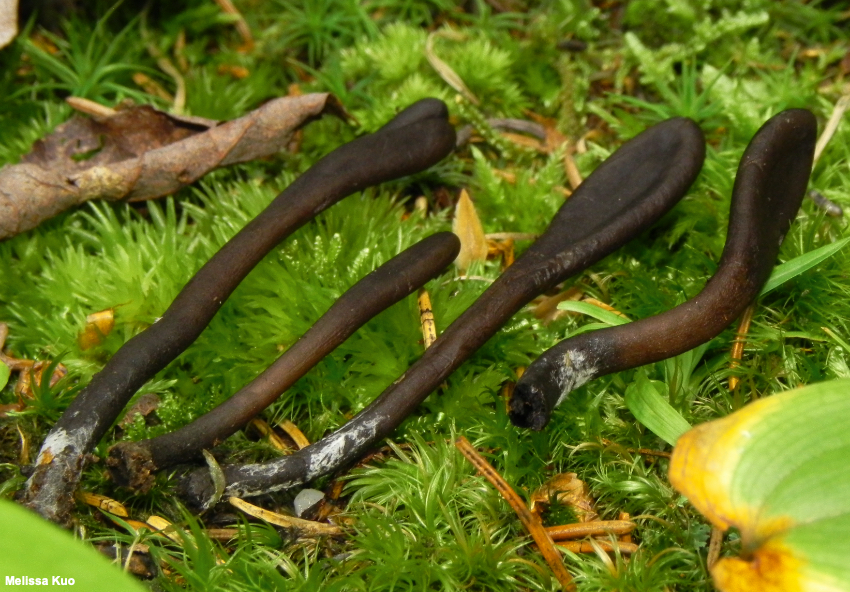
Geoglossum umbratile is a species of earth tongue fungus characterized by its dark, club-shaped fruiting bodies. It is a saprobic fungus, meaning it obtains nutrients from decaying organic matter, and is typically found in mossy areas, grasslands, and woodlands. Its appearance is often described as resembling a small, black tongue or club emerging from the ground.
How to Identify
- Cap
- The 'cap' or fertile head is typically 1-3 cm tall and 0.5-1.5 cm wide, club-shaped, spatulate, or somewhat compressed. It is black, smooth to minutely velvety, and often slightly viscid when moist. The margin is usually entire.
- Gills
- Geoglossum umbratile, like all earth tongues, is an ascomycete and does not possess gills. The spores are produced on the surface of the club-shaped head (hymenium).
- Stem
- The stem is continuous with the head, typically 1-5 cm long and 0.2-0.8 cm thick. It is black, smooth to minutely velvety, and often slightly viscid when moist, similar in texture and color to the head. It can be cylindrical or slightly compressed.
- Flesh
- The flesh is thin, tough, and blackish, with no distinctive odor or taste.
- Fruiting body
- The fruiting body is club-shaped to spatulate, often somewhat flattened or compressed, and typically measures 2-8 cm in height. It is entirely black or very dark brown, with a smooth to slightly velvety surface. The upper, fertile portion (head) is usually distinct from the stem, though sometimes gradually tapering.
- Habitat
- Saprobic, growing solitarily or in scattered groups on soil, often among mosses, in grasslands, open woodlands, and disturbed areas. It prefers moist, humus-rich soils.
Key Facts
- Cap surfaces: Smooth to minutely velvety, often slightly viscid when moist
- Growth Form: Solitary or scattered
- Spore Print: Dark brown to black (spores are dark)
- Body color: Black to very dark brown
- Odor: Indistinct
- Flesh bruises: Does not bruise
- Height: 2-8 cm
- Cap Diameter: 0.5-1.5 cm (width of the head)
- Nutrient gathering: Saprobic
Safe
SafeGeoglossum umbratile is generally considered inedible due to its small size, tough texture, and lack of culinary appeal. There are no reports of toxicity, but it is not consumed.
Quick Check
- Odor: Indistinct
- Fruiting: Late summer to late autumn
- Substrate: Soil, often among mosses
Where to Find
Temperate Regions
Widely distributed in temperate regions across North America, Europe, and parts of Asia.
Grasslands
Commonly found in undisturbed grasslands, especially those with a good layer of moss.
Open Woodlands
Can be found in open deciduous and coniferous woodlands, particularly in areas with rich organic matter.
Mossy Areas
Often associated with moss beds, where it can be easily overlooked due to its dark coloration.
Finding Tips
Seasonal Availability
Typically fruits from late summer through autumn, sometimes extending into early winter in milder climates.
Look for Moss
Focus your search in areas with dense moss growth, as this species frequently emerges from moss carpets.
Moist Conditions
Prefers moist conditions, so look after periods of rain.
Ground Level Search
These are small, dark fungi that can be easily missed. Scan the ground carefully, especially in shaded, damp spots.
Similar Species
Geoglossum glabrum
Earth Tongues
Also known as: Smooth Earth Tongue
Geoglossum cookeanum
Earth Tongues
Also known as: Cooke's Earth Tongue
Trichoglossum hirsutum
Hairy Earth Tongues
Also known as: Hairy Earth Tongue
Scientific Classification
- Phylum
- Ascomycota
- Class
- Leotiomycetes
- Order
- Geoglossales
- Family
- Geoglossaceae
- Genus
- Geoglossum
Storage Information
- Max Temperature: Not applicable
- Freezing duration: Not applicable
- Min Temperature: Not applicable
- Refrigeration: Not applicable
How to Clean
Not applicable, as this species is not considered edible. If handled for identification, simply brush off any soil or debris with a soft brush.
Explore Black Earth Tongue
Identify mushrooms anywhere
Free on iOS, Android, and Web. Photo identification, full database, and your personal collection.