
Got a photo? Identify mushrooms instantly with the Mushby app
Open the appDescription
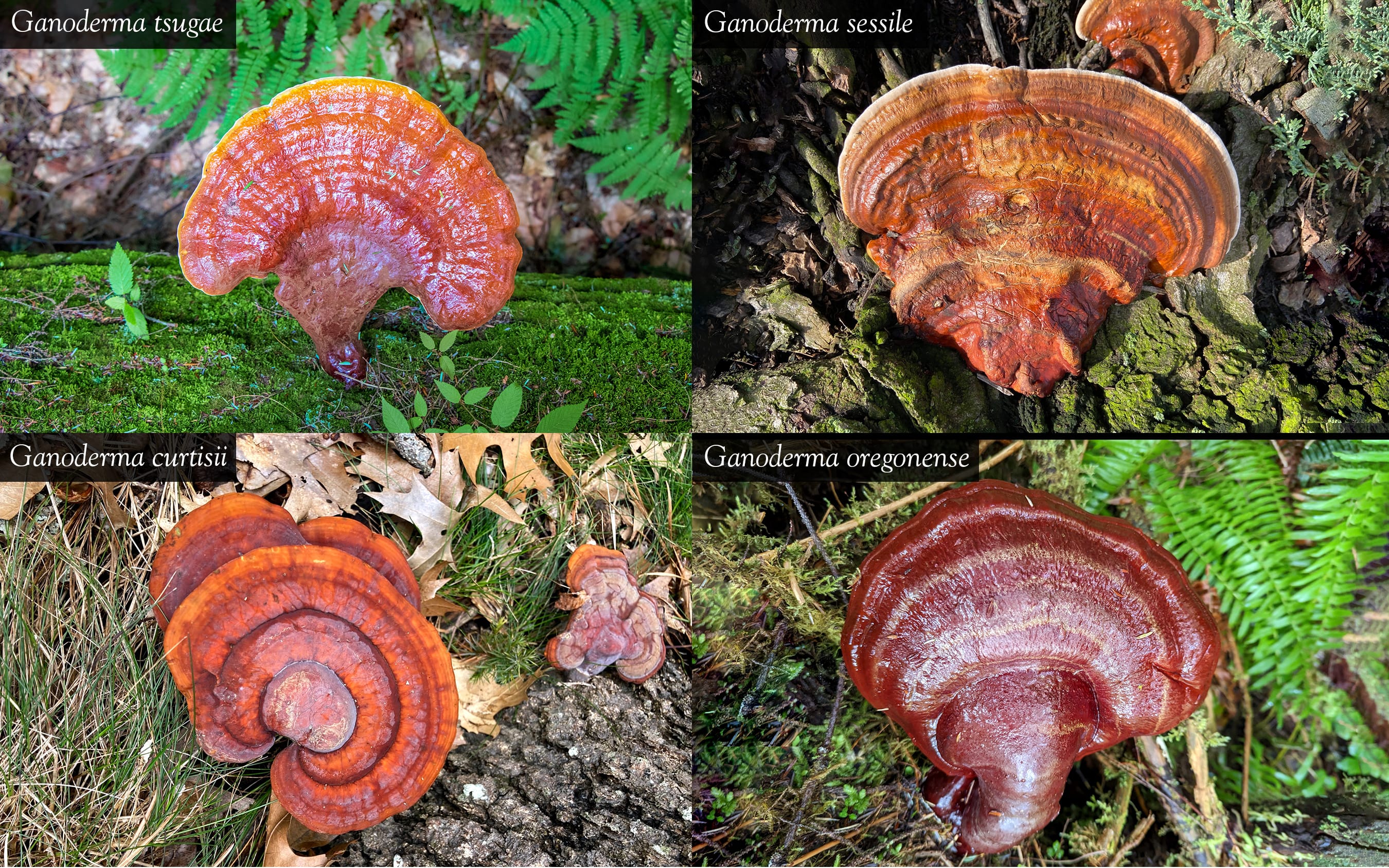
Ganoderma tsugae is a polypore bracket fungus that grows primarily on Hemlock trees (Tsuga species). It is valued in traditional medicine, although scientific evidence of its benefits are still emerging. It is closely related to Ganoderma lucidum, and often confused with it, but has distinct preference for hemlock and genetic differences.
How to Identify
- Cap
- The cap is typically 5-30 cm wide and 1-5 cm thick. The surface is laccate (shiny and varnished-looking), with concentric zones of color ranging from reddish-brown to orange or yellowish. The margin is usually rounded and lighter in color, often yellowish or whitish when young.
- Gills
- This is a polypore, meaning it has pores instead of gills. The pore surface is white to cream-colored when fresh, bruising brownish. Pores are small, typically 4-6 per mm.
- Stem
- A stem may be present or absent. If present, it is usually lateral (attaching to the side of the cap), short, and stout, with a shiny, reddish-brown surface similar to the cap.
- Flesh
- The flesh is tough, leathery, and corky, with a reddish-brown color. It lacks a distinct odor.
- Fruiting body
- A shelf-like or bracket-like fruit body, typically kidney-shaped or fan-shaped. It can be annual or perennial.
- Habitat
- Exclusively found on Hemlock trees (Tsuga species), either living or dead. It is a wood-decay fungus, causing a white rot.
Key Facts
- Cap surfaces: Laccate (shiny, varnished)
- Growth Form: Shelf-like, bracket-like
- Spore Print: Brown
- Body color: Reddish-brown, orange, yellowish
- Odor: Mild, not distinct
- Flesh bruises: No significant bruising
- Height: Variable, up to 5 cm
- Cap Diameter: 5-30 cm
- Nutrient gathering: Saprobic or parasitic (on Hemlock trees)
Safe
SafeGenerally considered non-toxic, but not typically consumed in large quantities as food due to its tough texture and bitter taste. Used primarily for medicinal teas and extracts. Allergic reactions are possible in sensitive individuals.
Quick Check
- Odor: Mild, slightly earthy or woody. Not distinct or pungent.
- Fruiting: On hemlock trees (Tsuga species). Shelf-like or bracket-like fruiting body with varnished appearance.
- Substrate: Hemlock wood (living or dead)
Where to Find
North America
Primarily found in eastern North America, wherever Hemlock trees are present. It can also be found to a lesser extent in the Pacific Northwest where Western Hemlock grows.
Hemlock Forests
Specifically searches for Eastern Hemlock (Tsuga canadensis) forests. Focus on areas with mature or decaying Hemlock trees.
Finding Tips
Season
Fruiting occurs primarily from late spring to fall. While technically perennial, the most robust and easily identifiable specimens are found during the growing season.
Dead or Dying Hemlock
Focus on fallen logs, stumps, and weakened but still standing Hemlock trees. Look for the characteristic shiny, reddish-brown brackets.
Elevation
In the Appalachian region, Ganoderma tsugae can be found at various elevations, from valley floors to higher slopes where Hemlock is prevalent.
Similar Species
Ganoderma lucidum
Bracket fungus
Also known as: Reishi (more broadly), Lingzhi
Ganoderma applanatum
Bracket fungus
Also known as: Artist's Conk
Ganoderma sessile
Bracket fungus
Also known as: Reishi
Scientific Classification
- Phylum
- Basidiomycota
- Class
- Agaricomycetes
- Order
- Polyporales
- Family
- Ganodermataceae
- Genus
- Ganoderma
Storage Information
- Max Temperature: Room Temperature (approximately 20-25°C)
- Freezing duration: Not recommended for long-term storage; may degrade compounds.
- Min Temperature: Refrigerate (approximately 2-4°C)
- Refrigeration: Up to 1-2 weeks. Ensure it's dry before refrigerating to prevent mold.
How to Clean
Clean using a soft brush to remove any debris. Avoid washing unless absolutely necessary. If washing, dry thoroughly immediately after.
Explore Hemlock Reishi, Reishi
Identify mushrooms anywhere
Free on iOS, Android, and Web. Photo identification, full database, and your personal collection.