
Got a photo? Identify mushrooms instantly with the Mushby app
Open the appDescription
Flammulina velutipes, commonly known as the winter mushroom, velvet foot, or enokitake, is a species of agaric fungus in the family Physalacriaceae. It is well-known for its cultivated form, which is often used in Asian cuisine.
How to Identify
- Cap
- The cap of the wild winter mushroom is typically 2-8 cm in diameter, convex to flattened, and has a sticky surface when moist. Cultivated forms have smaller caps.
- Gills
- The gills are white to yellowish, closely spaced, and adnate to slightly decurrent.
- Stem
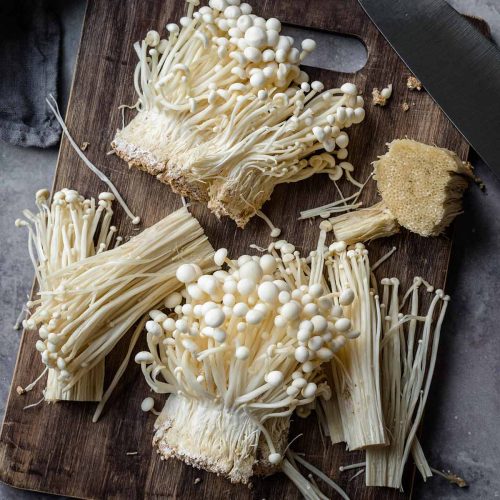
- The stem is velvety, dark brown to black near the base, and lighter towards the top. Cultivated forms have longer, thinner, and white stems.
- Flesh
- The flesh is thin and white to yellowish.
- Fruiting body
- The fruiting body of Flammulina velutipes varies depending on whether it is wild or cultivated. Wild specimens typically have a dark orange to brown cap, while cultivated ones have a pale white cap and a longer, thinner stem.
- Habitat
- Flammulina velutipes grows on decaying wood, especially on elm, ash, and willow trees. It can be found in clusters during the late fall and winter months.
Key Facts
- Cap surfaces: Sticky when moist
- Growth Form: Clustered
- Spore Print: White
- Body color: Orange-brown (wild), White (cultivated)
- Odor: Mild
- Flesh bruises: Does not bruise
- Height: 2-10 cm
- Cap Diameter: 2-8 cm
- Nutrient gathering: Saprophytic
Safe
SafeFlammulina velutipes is generally considered safe to eat when cooked. However, it should not be eaten raw, as it can cause gastrointestinal upset in some individuals.
Quick Check
- Odor: Mild and pleasant
- Fruiting: Late fall to winter
- Substrate: Decaying wood of deciduous trees
Where to Find
North America
Found in forests across North America, particularly in the eastern regions.
Europe
Common in many European countries, growing on deadwood in forests and woodlands.
Asia
Widely distributed in Asia, including Japan, China, and Korea, where it is also cultivated.
Finding Tips
Check Deciduous Trees
Look for Flammulina velutipes on dead or dying deciduous trees, especially elm, ash, and willow. They often grow in clusters.
Late Fall and Winter
Search for these mushrooms during the late fall and winter months when other mushrooms are scarce. They can withstand freezing temperatures.
Examine the Stem
The velvety, dark brown to black stem is a key identifying feature. Make sure to check this characteristic closely.
Similar Species
Galerina marginata
fungus
Also known as: Funeral Bell
Scientific Classification
- Phylum
- Basidiomycota
- Class
- Agaricomycetes
- Order
- Agaricales
- Family
- Physalacriaceae
- Genus
- Flammulina
Storage Information
- Max Temperature: 4°C (39°F)
- Freezing duration: 3 months
- Min Temperature: 1°C (34°F)
- Refrigeration: 1 week
How to Clean
To clean Flammulina velutipes, trim off the base of the stem where it was attached to the wood. Gently wipe the caps with a damp cloth to remove any debris. Avoid soaking them in water, as they can become waterlogged.
Explore Winter Mushroom
Identify mushrooms anywhere
Free on iOS, Android, and Web. Photo identification, full database, and your personal collection.