
How to identify Crystal Brain Fungus
Exidia nucleata
Got a photo? Identify mushrooms instantly with the Mushby app
Open the appTo correctly identify Crystal Brain Fungus (Exidia nucleata), check each of these features in order. Misidentification is the most common cause of mushroom poisoning, so cross-reference multiple sources.
Step-by-step identification
- 1
Cap
Shape, color, surface texture, and diameter.
Not applicable, as Exidia nucleata does not form a cap in the traditional sense. The entire fruiting body is the reproductive structure.
- 2
Gills
Attachment to stem, color, and spacing.
Not applicable, as Exidia nucleata is a jelly fungus and does not produce gills.
- 3
Stem
Length, shape, surface, and any ring.
Not applicable, as Exidia nucleata is sessile or broadly attached to the substrate without a distinct stem.
- 4
Flesh
Color, texture, and bruising reaction.
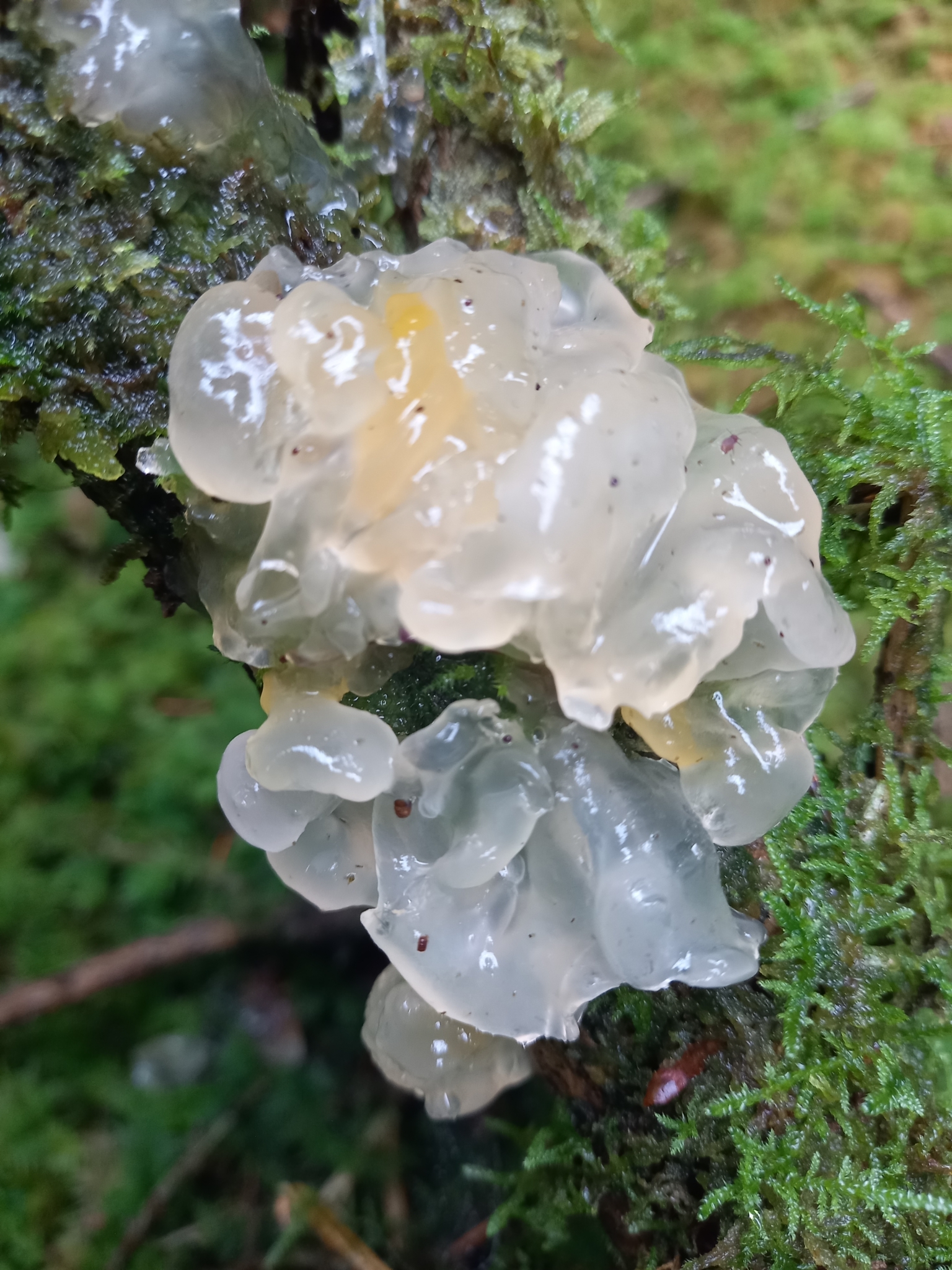
Gelatinous, translucent, and somewhat rubbery when fresh. It becomes hard and horny when dry, rehydrating to its original texture when wet.
- 5
Fruiting body
Overall growth pattern.
The fruiting body is typically 1-5 cm across, irregularly lobed, convoluted, or brain-like, often appearing as a cluster of smaller, fused lobes. It is gelatinous, translucent to whitish or pale grey, sometimes with a yellowish or brownish tinge, especially with age or drying. The most distinctive feature is the presence of numerous small, opaque, white, granular inclusions (nuclei) embedded within the gelatinous mass. These are sterile aggregations of hyphae and are visible to the naked eye.
- 6
Habitat
Where it grows and on what substrate.
Saprobic on dead hardwood, particularly fallen branches and logs of oak (Quercus spp.) and beech (Fagus spp.). It can also be found on other deciduous trees. It typically grows on decorticated (barkless) wood but can sometimes be found on bark.
Key Facts
- Cap surfaces
- Not applicable (no cap)
- Growth Form
- Effused-reflexed to pulvinate, often confluent
- Spore Print
- White
- Body color
- Translucent to whitish, pale grey, sometimes yellowish or brownish
- Odor
- Indistinct
- Flesh bruises
- Does not bruise
- Height
- Not applicable (sessile)
- Cap Diameter
- 1-5 cm across (fruiting body)
Fruit body characteristics
- Gill attachment: Not applicable (no gills)
- Stem shape: Not applicable (no stem)
- Stem surface: Not applicable (no stem)
- Ring: Absent
- Stem cross-section: Not applicable (no stem)
Explore Crystal Brain Fungus
Identify mushrooms anywhere
Free on iOS, Android, and Web. Photo identification, full database, and your personal collection.