
Got a photo? Identify mushrooms instantly with the Mushby app
Open the appDescription
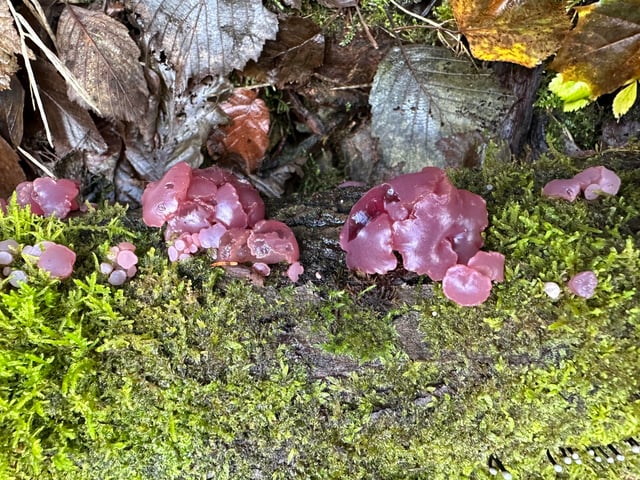
Exidia glandulosa is a common and widespread species of jelly fungus, characterized by its gelatinous, brain-like or convoluted fruiting bodies that are typically black or very dark brown. It is saprobic, growing on dead deciduous wood, particularly oak and beech. When fresh, it is soft and gelatinous; upon drying, it shrinks and hardens to a thin, black crust, reviving to its original form when rehydrated by rain. It is often found in clusters or spreading patches.
How to Identify
- Cap
- Not applicable, as Exidia glandulosa does not form a distinct cap. The entire fruiting body is the reproductive structure.
- Gills
- Not applicable, as Exidia glandulosa is a jelly fungus and does not produce gills.
- Stem
- Not applicable, as Exidia glandulosa is sessile, attaching directly to the substrate without a distinct stem.
- Flesh
- Gelatinous and firm when fresh and moist, becoming cartilaginous and hard when dry. The interior is uniformly black or dark brown.
- Fruiting body
- The fruiting body is typically 1-6 cm across and 1-3 cm high, irregularly lobed, convoluted, or brain-like, often appearing as a mass of fused, individual blobs. It is black to very dark brown, shiny and somewhat translucent when wet, becoming dull and hard when dry. The surface is often covered with minute, wart-like projections (glands), which are more noticeable when the fungus is dry or partially dried.
- Habitat
- Saprobic on dead deciduous wood, particularly fallen branches and logs of oak (Quercus spp.) and beech (Fagus spp.). It can also be found on other hardwoods. It causes a white rot in the wood.
Key Facts
- Cap surfaces: Not applicable (no cap)
- Growth Form: Irregularly lobed, convoluted, brain-like, or cushion-shaped masses, often confluent.
- Spore Print: White
- Body color: Black to very dark brown
- Odor: Indistinct
- Flesh bruises: Does not bruise
- Height: 1-3 cm
- Cap Diameter: 1-6 cm (overall spread)
- Nutrient gathering: Saprobic
Safe
SafeExidia glandulosa is generally considered non-toxic, but it is not typically consumed due to its texture and lack of culinary appeal. There are no known toxins associated with this species. However, as with any wild mushroom, individual sensitivities can occur.
Quick Check
- Odor: Indistinct or earthy
- Fruiting: Year-round, especially after rain
- Substrate: Dead deciduous wood (saprobic)
Where to Find
Deciduous Forests
Commonly found in deciduous woodlands across temperate regions of the Northern Hemisphere, particularly where oak and beech trees are prevalent.
Fallen Logs and Branches
Look for it growing on dead, decaying hardwood logs, branches, and stumps, often on the underside or sides of the wood.
Finding Tips
Moisture is Key
This fungus is most prominent and easily identifiable after rain or during periods of high humidity, when its gelatinous texture is fully hydrated. In dry conditions, it can shrink to an inconspicuous black crust.
Check Hardwoods
Focus your search on dead wood from deciduous trees, especially oak and beech. It rarely grows on conifers.
Look for Clusters
Exidia glandulosa often grows in gregarious clusters or spreading patches, sometimes covering significant areas of a log.
Similar Species
Witch's Butter
jelly fungus
Also known as: Yellow Brain Fungus, Golden Jelly Fungus
Amber Jelly Roll
jelly fungus
Also known as: Brown Witch's Butter
Crystal Brain Fungus
jelly fungus
Also known as: White Brain Fungus
Scientific Classification
- Phylum
- Basidiomycota
- Class
- Agaricomycetes
- Order
- Auriculariales
- Family
- Auriculariaceae
- Genus
- Exidia
Storage Information
- Max Temperature: Not applicable for culinary storage.
- Freezing duration: Not applicable for culinary storage.
- Min Temperature: Not applicable for culinary storage.
- Refrigeration: Not applicable for culinary storage.
How to Clean
Due to its gelatinous texture and typical growth on decaying wood, Exidia glandulosa is generally not collected for culinary purposes. If one were to collect it for study, a soft brush could remove loose debris, but washing is not recommended as it can absorb water and become overly saturated.
Explore Black Witch's Butter
Identify mushrooms anywhere
Free on iOS, Android, and Web. Photo identification, full database, and your personal collection.