
Got a photo? Identify mushrooms instantly with the Mushby app
Open the appDescription
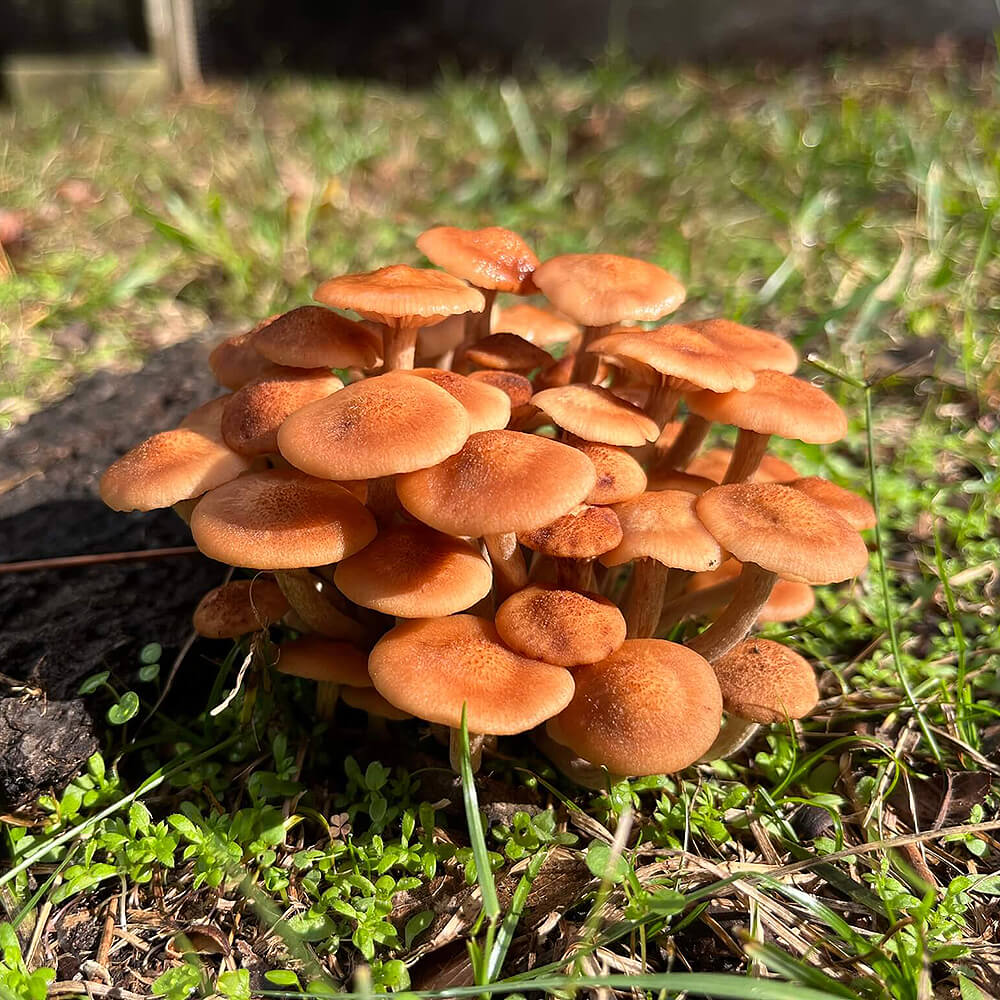
A saprobic and facultatively parasitic fungus known for growing in dense, cespitose clusters on hardwoods. It is distinguished from true Armillaria species by the total absence of a ring (annulus) on the stipe and its often slightly smaller stature.
How to Identify
- Cap
- 3-10 cm, convex to flattened, tawny-yellow to reddish-brown, with fine dark scales particularly in the center.
- Gills
- Adnate to decurrent, white to cream, becoming brownish with age or handling.
- Stem
- 5-15 cm long, smooth, fibrous, tapering downwards, tan to brown, base often fused with other mushrooms; notably lacks any ring.
- Flesh
- White to whitish, unchanging when sliced.
- Fruiting body
- Clusters of small to medium mushrooms growing in dense, joined groups.
- Habitat
- Clustered on decaying hardwood logs, stumps, or at the base of living trees.
Key Facts
- Cap surfaces: Fine dark squamules or scales on a yellowish-brown background.
- Growth Form: Cespitose (densely clustered).
- Spore Print: White.
- Body color: Honey-yellow to reddish-brown.
- Odor: Mild and non-distinctive.
- Flesh bruises: No significant color change, though gills may darken.
- Height: 5-15 cm.
- Cap Diameter: 3-10 cm.
- Nutrient gathering: Saprobic and facultatively parasitic.
Safe
SafeEdible, but must be thoroughly cooked. Consuming raw or undercooked mushrooms can lead to gastrointestinal distress. Some individuals may experience sensitivities.
Quick Check
- Odor: Pleasantly mild, slightly fungal or 'mushroomy'.
- Fruiting: Late summer to late autumn.
- Substrate: Decaying hardwood, particularly oak, though sometimes found near conifers.
Where to Find
Eastern North America
Highly abundant in forests throughout the Eastern United States and Canada.
Global Distribution
Found across various temperate regions in the Northern Hemisphere.
Finding Tips
Look for the base
Always check for the cluster origin at the base of stumps or roots, as these are prolific growers on wood.
Check for rings
Examine the stipe carefully; if a ring or remnant of a veil is present, it is not Desarmillaria caespitosa.
Similar Species
Honey Mushroom
Armillaria mellea
Also known as: Armillaria species with rings
Jack O'Lantern
Omphalotus olearius
Also known as: Omphalotus illudens
Scientific Classification
- Phylum
- Basidiomycota
- Class
- Agaricomycetes
- Order
- Agaricales
- Family
- Physalacriaceae
- Genus
- Desarmillaria
Storage Information
- Max Temperature: 4 degrees Celsius
- Freezing duration: Up to 6 months if blanched/cooked
- Min Temperature: 1 degree Celsius
- Refrigeration: 3 to 5 days in a paper bag
How to Clean
Use a soft brush to remove debris; rinse briefly if necessary but avoid soaking as they absorb water easily.
Explore Ringless Honey Mushroom
Identify mushrooms anywhere
Free on iOS, Android, and Web. Photo identification, full database, and your personal collection.