
Got a photo? Identify mushrooms instantly with the Mushby app
Open the appDescription
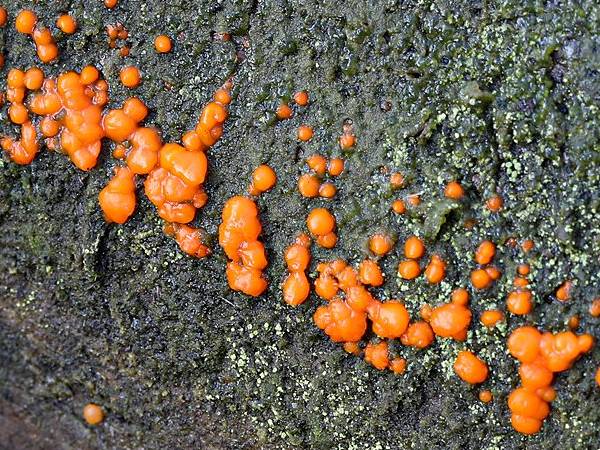
Dacrymyces stillatus, commonly known as Orange Jelly Spot or Gumdrop Fungus, is a widespread and common jelly fungus. It is characterized by its small, gelatinous, and typically orange to yellowish-orange fruiting bodies that appear on dead wood. It is a saprobic species, playing a role in the decomposition of wood.
How to Identify
- Cap
- Not applicable, as Dacrymyces stillatus does not form a cap in the traditional sense. The entire fruiting body is a gelatinous mass.
- Gills
- Not applicable, as Dacrymyces stillatus is a jelly fungus and does not produce gills.
- Stem
- Not applicable, as Dacrymyces stillatus does not have a distinct stem; it is sessile or broadly attached to the substrate.
- Flesh
- The flesh is gelatinous, translucent, and uniformly colored like the surface.
- Fruiting body
- The fruiting bodies are typically 1-5 mm in diameter, hemispherical to cushion-shaped, often becoming somewhat convoluted or brain-like when mature or growing in clusters. They are gelatinous and rubbery, ranging in color from bright orange to yellowish-orange, sometimes fading to pale yellow or whitish with age or desiccation. When dry, they shrink considerably and become hard, resembling a thin, orange crust; they revive and regain their gelatinous texture when rehydrated by rain.
- Habitat
- Saprobic, growing on dead, decorticated (barkless) or bark-covered wood of both coniferous and deciduous trees. It is particularly common on fallen branches and logs, often appearing in large numbers.
Key Facts
- Cap surfaces: Not applicable (entire fruiting body is gelatinous)
- Growth Form: Sessile, cushion-shaped to convoluted, often gregarious or confluent
- Spore Print: White to pale yellow
- Body color: Bright orange to yellowish-orange
- Odor: Indistinct
- Flesh bruises: Does not bruise
- Height: 1-5 mm
- Cap Diameter: 1-5 mm
- Nutrient gathering: Saprobic
Safe
SafeDacrymyces stillatus is considered non-toxic, but it is not typically consumed due to its small size, gelatinous texture, and lack of culinary appeal. It has no known toxic compounds.
Quick Check
- Odor: Indistinct or none
- Fruiting: Year-round, especially after rain or during moist periods
- Substrate: Dead wood (coniferous and deciduous)
Where to Find
Forests and Woodlands
Commonly found in various forest types, including coniferous, deciduous, and mixed woodlands, wherever dead wood is present.
Parks and Gardens
Can be found on dead wood in urban and suburban green spaces, such as parks and gardens.
Finding Tips
Look for Dead Wood
Focus your search on fallen branches, logs, and stumps, especially those that are well-rotted and moist.
Check After Rain
These fungi are most conspicuous and easily identifiable when they are hydrated after rainfall, appearing as bright, glistening orange spots.
Examine Both Coniferous and Deciduous Wood
While often found on conifers, it can also occur on hardwoods, so check all types of dead wood.
Similar Species
Orange Jelly
jelly fungus
Also known as: Witches' Butter
Yellow Brain Fungus
jelly fungus
Also known as: Golden Jelly Fungus
Crystal Brain Fungus
jelly fungus
Also known as: White Brain Fungus
Scientific Classification
- Phylum
- Basidiomycota
- Class
- Dacrymycetes
- Order
- Dacrymycetales
- Family
- Dacrymycetaceae
- Genus
- Dacrymyces
Storage Information
- Max Temperature: Not applicable for culinary purposes.
- Freezing duration: Not applicable for culinary purposes.
- Min Temperature: Not applicable for culinary purposes.
- Refrigeration: Not applicable for culinary purposes.
How to Clean
Not applicable for culinary purposes. If collected for scientific study, gentle brushing with a soft brush or a damp cloth can remove debris.
Explore Orange Jelly Spot
Identify mushrooms anywhere
Free on iOS, Android, and Web. Photo identification, full database, and your personal collection.