
Got a photo? Identify mushrooms instantly with the Mushby app
Open the appDescription
Cortinarius trivialis, commonly known as the Weeping Widow, is a species of mushroom in the family Cortinariaceae. It is characterized by its slimy cap and stem, and its ochre-brown gills. This mushroom is found in deciduous forests, often near birch or willow trees. While not considered highly toxic, it is generally not recommended for consumption due to its unpalatable taste and potential for confusion with more poisonous species.
How to Identify
- Cap
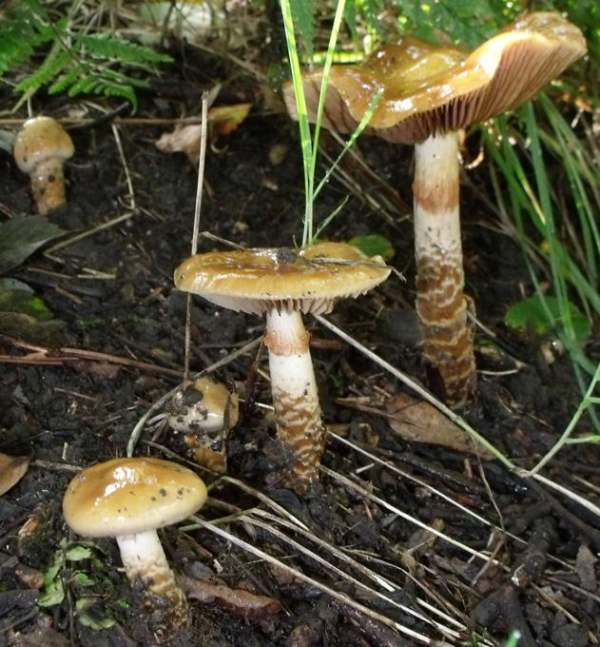
- The cap is typically 3-8 cm in diameter, convex to flattened, and has a slimy, glutinous surface. The color ranges from ochre to tan or light brown. The margin is often incurved when young and may have remnants of the cortina (a cobweb-like partial veil).
- Gills
- The gills are adnate to slightly decurrent, closely spaced, and ochre-brown in color. They may become more rusty-brown as the spores mature.
- Stem
- The stem is 5-12 cm long and 1-2 cm thick, cylindrical, and slimy, especially when young. The color is similar to the cap or slightly paler. There may be remnants of the cortina forming a faint ring zone on the upper part of the stem.
- Flesh
- The flesh is whitish to pale ochre, and does not typically exhibit any significant color changes when bruised.
- Fruiting body
- The fruiting body of Cortinarius trivialis is a medium-sized mushroom with a slimy cap and stem. The overall appearance is ochre to brownish, with a viscid surface.
- Habitat
- Cortinarius trivialis is found in deciduous forests, particularly near birch and willow trees. It is a mycorrhizal fungus, forming symbiotic relationships with the roots of these trees. It typically fruits in the autumn.
Key Facts
- Cap surfaces: Slimy, glutinous
- Growth Form: Solitary to scattered
- Spore Print: Rusty-brown
- Body color: Ochre to brownish
- Odor: Mild
- Flesh bruises: No significant color change
- Height: 5-12 cm
- Cap Diameter: 3-8 cm
- Nutrient gathering: Mycorrhizal
Safe
Mild ToxicityCortinarius trivialis is not considered highly toxic, but it is generally not recommended for consumption due to its unpalatable taste and potential for confusion with more poisonous Cortinarius species.
Quick Check
- Odor: Mild, not distinctive
- Fruiting: Autumn
- Substrate: Decaying leaves and forest litter under deciduous trees
Where to Find
Europe
Common throughout Europe, especially in northern and central regions.
North America
Found in some parts of North America, particularly in areas with similar deciduous forests.
Finding Tips
Look Near Host Trees
Search in deciduous forests, especially near birch and willow trees, as Cortinarius trivialis forms mycorrhizal associations with these trees.
Check in Autumn
The mushroom typically fruits in the autumn months, so this is the best time to search for it.
Feel for Sliminess
The slimy cap and stem are key identifying features, so check for this texture when identifying potential specimens.
Similar Species
Cortinarius collinitus
Mushroom
Also known as: Slimy Cortinarius
Cortinarius mucosus
Mushroom
Also known as: Orange Webcap
Scientific Classification
- Phylum
- Basidiomycota
- Class
- Agaricomycetes
- Order
- Agaricales
- Family
- Cortinariaceae
- Genus
- Cortinarius
Storage Information
- Max Temperature: 4°C (39°F)
- Freezing duration: 3-6 months
- Min Temperature: 2°C (36°F)
- Refrigeration: 2-3 days
How to Clean
Cleaning Cortinarius trivialis is challenging due to its slimy surface. Gently wipe off any debris with a damp cloth. Avoid soaking the mushroom in water, as it can become waterlogged. The slimy layer can be peeled off if desired, but this is not necessary.
Explore Weeping Widow
Identify mushrooms anywhere
Free on iOS, Android, and Web. Photo identification, full database, and your personal collection.