
Got a photo? Identify mushrooms instantly with the Mushby app
Open the appDescription
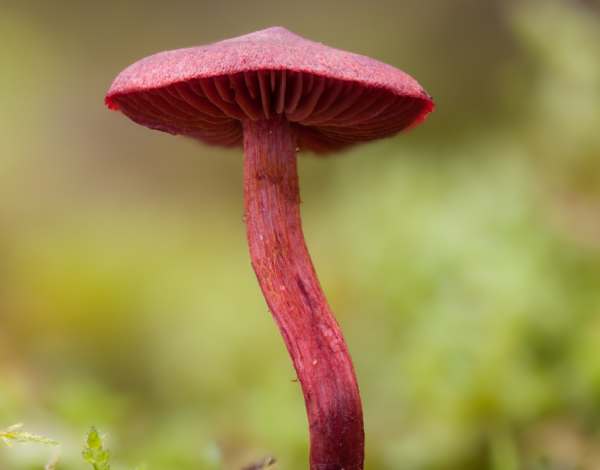
Cortinarius semisanguineus is a striking mushroom characterized by its dull, olive-brown to yellowish-brown cap and distinctively blood-red to saffron-red gills. It is a common species found in coniferous and mixed woodlands, particularly under pine and spruce. Like all Cortinarius species, it possesses a cortina (a cobweb-like partial veil) in its young stages, which often leaves a rusty spore print on the stem. This mushroom is considered toxic and should not be consumed.
How to Identify
- Cap
- The cap is 2-8 cm in diameter, convex to broadly convex or nearly flat with age, often with a low umbo. The color ranges from dull olive-brown to yellowish-brown, sometimes with reddish tints, especially towards the center. The surface is dry, finely fibrillose to minutely scaly, and often somewhat velvety. The margin is incurved when young, becoming straight with age, and may show remnants of the cortina.
- Gills
- The gills are adnate to sinuate, crowded, and initially a striking blood-red to saffron-red, becoming rusty cinnamon-brown with age due to the maturing spores. They are the most distinctive feature of this species. A cobweb-like cortina is present in young specimens, connecting the cap margin to the stem, often leaving rusty spore deposits on the stem as it breaks.
- Stem
- The stem is 3-10 cm long and 0.5-1.5 cm thick, cylindrical or slightly clavate (club-shaped) towards the base. The color is yellowish to olive-yellow, often paler than the cap, and may have reddish-brown stains, especially towards the base. The surface is dry and fibrillose, often with rusty zones or remnants of the cortina. It is solid when young, becoming hollow with age.
- Flesh
- The flesh is yellowish to olive-yellow in the cap and stem, sometimes reddish-brown in the stem base. It is relatively thin and does not change color when cut or bruised. The odor is indistinct or slightly radish-like, and the taste is mild.
- Fruiting body
- The fruiting body is typically medium-sized, with a cap diameter of 2-8 cm and a stem height of 3-10 cm.
- Habitat
- Cortinarius semisanguineus is a mycorrhizal fungus, forming symbiotic relationships primarily with coniferous trees, especially pine (Pinus spp.) and spruce (Picea spp.). It can also be found in mixed woodlands. It grows solitarily or scattered on the ground in moss or leaf litter.
Key Facts
- Cap surfaces: Dry, finely fibrillose to minutely scaly, velvety
- Growth Form: Solitary or scattered
- Spore Print: Rusty brown
- Body color: Cap: olive-brown to yellowish-brown; Gills: blood-red to saffron-red; Stem: yellowish to olive-yellow
- Odor: Indistinct or slightly radish-like
- Flesh bruises: No significant bruising reaction
- Height: 3-10 cm
- Cap Diameter: 2-8 cm
- Nutrient gathering: Mycorrhizal
Toxic
Severe ToxicityCortinarius semisanguineus is considered toxic. While it does not contain the deadly orellanine toxins found in some other Cortinarius species (like C. orellanus and C. rubellus), it is known to cause gastrointestinal upset, including nausea, vomiting, and diarrhea. The exact toxic compounds are not fully understood, but consumption is strongly discouraged due to potential adverse reactions and the risk of misidentification with more deadly Cortinarius species.
Quick Check
- Odor: Indistinct or slightly radish-like
- Fruiting: Late summer to autumn
- Substrate: Ground, in moss or leaf litter, associated with conifers
Where to Find
Coniferous Forests
Commonly found under pine and spruce trees.
Mixed Woodlands
Can also occur in forests with a mix of coniferous and deciduous trees.
Mossy Areas
Often grows in moss beds on the forest floor.
Finding Tips
Look for Conifers
Focus your search in areas dominated by pine and spruce trees, as this mushroom forms mycorrhizal associations with them.
Check the Gills
The most distinguishing feature is the vibrant red to saffron-red gills. Always check this characteristic carefully.
Observe the Cortina
In young specimens, look for the cobweb-like veil (cortina) connecting the cap margin to the stem. This will often be stained rusty by spores.
Seasonal Timing
This species typically fruits from late summer through autumn.
Similar Species
Deadly Webcap
Cortinarius
Also known as: Fool's Webcap
Orange-gilled Cortinarius
Cortinarius
Also known as: Cortinarius orellanus
Cinnamon Cortinarius
Cortinarius
Also known as: Cortinarius cinnamomeus
Scientific Classification
- Phylum
- Basidiomycota
- Class
- Agaricomycetes
- Order
- Agaricales
- Family
- Cortinariaceae
- Genus
- Cortinarius
Explore Red-gilled Cortinarius
Identify mushrooms anywhere
Free on iOS, Android, and Web. Photo identification, full database, and your personal collection.