Got a photo? Identify mushrooms instantly with the Mushby app
Open the appDescription
Cortinarius iodes, commonly known as the Purple Cort, is a striking mushroom characterized by its vibrant purple coloration and slimy or viscid cap. It is a mycorrhizal fungus, typically found in association with oak trees. Its distinctive appearance makes it relatively easy to identify among other Cortinarius species, though caution is always advised due to the genus's reputation for containing many toxic species.
How to Identify
- Cap
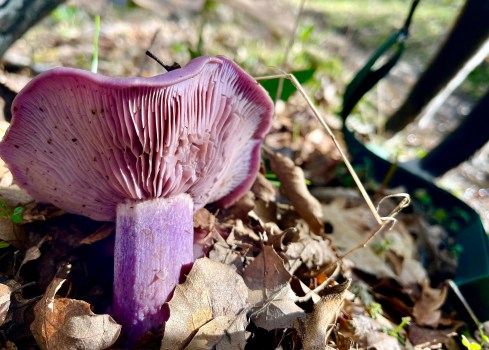
- The cap is 2-7 cm (0.8-2.8 inches) in diameter, convex to broadly convex or nearly flat in maturity, often with a low, broad umbo. It is distinctly viscid to slimy, especially when moist, and shiny when dry. The color is typically a vibrant purple, violet, or purplish-brown, often fading to a duller purplish-tan or brownish-purple with age, especially towards the margin. The margin is usually inrolled when young and can be somewhat striate when wet.
- Gills
- The gills are adnate to adnexed, close to crowded, and initially bright purple, violet, or lilac. As the mushroom matures and spores develop, they become rusty brown due to the spore print. A cortina (cobweb-like veil) is present in young specimens, connecting the cap margin to the stem, and often leaves rusty brown remnants on the stem as it breaks.
- Stem
- The stem is 3-8 cm (1.2-3.1 inches) long and 0.5-1.5 cm (0.2-0.6 inches) thick, equal or slightly tapering towards the base, sometimes with a slightly swollen base. It is solid, fibrillose, and typically purplish, especially towards the apex, often fading to whitish or pale yellowish-brown towards the base. Rusty brown remnants of the cortina are often visible on the upper part of the stem.
- Flesh
- The flesh is whitish to pale lilac or purplish, especially in the cap, and does not change color when cut or bruised. It has a mild, indistinct odor and taste.
- Fruiting body
- The fruiting body is typically medium-sized, with a cap and stem, and a distinct cortina (cobweb-like veil) when young.
- Habitat
- Cortinarius iodes is a mycorrhizal fungus, forming symbiotic relationships primarily with oak trees (Quercus species). It is found growing solitarily or scattered on the ground in deciduous and mixed forests, particularly under oaks.
Key Facts
- Cap surfaces: Viscid to slimy, shiny when dry
- Growth Form: Solitary or scattered
- Spore Print: Rusty brown
- Body color: Vibrant purple to violet, fading with age
- Odor: Indistinct
- Flesh bruises: No significant color change
- Height: 3-8 cm (1.2-3.1 inches)
- Cap Diameter: 2-7 cm (0.8-2.8 inches)
- Nutrient gathering: Mycorrhizal
Toxic
Severe ToxicityCortinarius iodes is considered inedible and potentially toxic. While specific toxins are not as well-documented as in some other Cortinarius species (e.g., those containing orellanine), the genus Cortinarius is notorious for containing many deadly or severely toxic species. Therefore, all Cortinarius species, including Cortinarius iodes, should be treated as poisonous and never consumed. Ingestion can lead to gastrointestinal upset, and potentially more severe, though less understood, effects.
Quick Check
- Odor: Indistinct or mild
- Fruiting: Summer to Fall
- Substrate: Ground, mycorrhizal with oak trees
Where to Find
Eastern North America
Commonly found in deciduous and mixed forests, particularly in association with oak trees.
Midwestern United States
Present in oak-dominated woodlands.
Finding Tips
Look for Oak Trees
Focus your search in forests dominated by oak trees, as Cortinarius iodes forms a mycorrhizal relationship with them.
Check After Rain
The viscid cap is most noticeable after rainfall, making identification easier. Look for its vibrant purple color against the forest floor.
Examine Young Specimens
The cortina is most evident in young mushrooms, which can help confirm its identity as a Cortinarius species. The gills will also be a more vibrant purple before spore development.
Similar Species
Cortinarius violaceus
Cortinarius
Also known as: Violet Webcap
Cortinarius iodeoides
Cortinarius
Also known as: Pungent Cort
Scientific Classification
- Phylum
- Basidiomycota
- Class
- Agaricomycetes
- Order
- Agaricales
- Family
- Cortinariaceae
- Genus
- Cortinarius
Explore Purple Cort
Identify mushrooms anywhere
Free on iOS, Android, and Web. Photo identification, full database, and your personal collection.