
Got a photo? Identify mushrooms instantly with the Mushby app
Open the appDescription
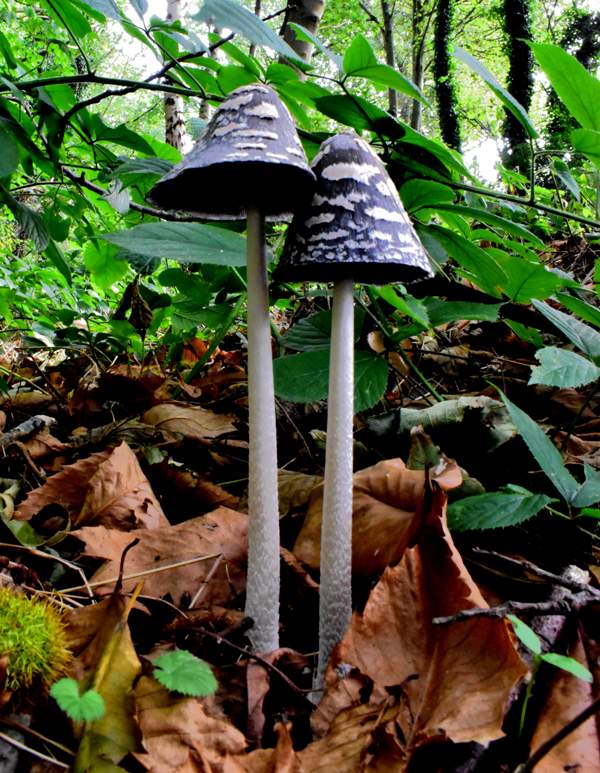
Coprinopsis picacea, commonly known as the Magpie Inkcap, is a distinctive and elegant mushroom belonging to the family Psathyrellaceae. It is characterized by its striking blackish-brown cap covered with prominent white, woolly scales, giving it a pied or 'magpie-like' appearance. Like other inkcaps, its gills undergo autodigestion (deliquescence) into a black, inky liquid as the spores mature. This species is saprobic, growing on decaying wood, often buried, in deciduous woodlands.
How to Identify
- Cap
- The cap is typically 3-8 cm in diameter and 5-12 cm tall when young, becoming broadly conical to campanulate. Its color is dark blackish-brown to sepia, covered with conspicuous, persistent, white to off-white, woolly or shaggy scales, especially when young. The margin often splits and curls upwards as it deliquesces.
- Gills
- The gills are free, crowded, and initially white, turning pinkish-grey, then black, and finally deliquescing into a black, inky liquid from the margin inwards.
- Stem
- The stem is 10-20 cm long and 0.5-1.5 cm in diameter, slender, hollow, and brittle. It is white to off-white, often with fine, silky fibrils, and may have a slightly swollen base. There is no ring, though a faint, evanescent ring zone may sometimes be present from the partial veil remnants.
- Flesh
- The flesh is thin, whitish, and fragile. It has no distinctive taste but often has a somewhat unpleasant, radish-like or slightly fetid odor.
- Fruiting body
- The fruiting body is initially ovoid to cylindrical, expanding to campanulate (bell-shaped) as it matures, eventually deliquescing.
- Habitat
- Saprobic, growing solitarily or in small groups on rich, often disturbed, soil or directly on decaying buried wood (hardwood, rarely conifer) in deciduous or mixed woodlands. It prefers calcareous soils.
Key Facts
- Cap surfaces: Dark blackish-brown with prominent white, woolly scales.
- Growth Form: Solitary or scattered.
- Spore Print: Black.
- Body color: Cap: blackish-brown with white scales; Stem: white.
- Odor: Unpleasant, radish-like.
- Flesh bruises: Does not bruise significantly.
- Height: 10-20 cm
- Cap Diameter: 3-8 cm
- Nutrient gathering: Saprobic
Toxic
Severe ToxicityCoprinopsis picacea is considered inedible due to its unpleasant taste and odor, and it is suspected to contain toxins that can cause gastrointestinal upset. While not as well-studied as Coprinopsis atramentaria (Common Inkcap) for its coprine content, it is generally advised against consumption. Some sources suggest it may contain coprine-like compounds, which would cause an Antabuse-like reaction when consumed with alcohol, similar to Coprinopsis atramentaria. However, this is not definitively confirmed for C. picacea. Regardless, its unpleasant characteristics make it unsuitable for culinary use.
Quick Check
- Odor: Unpleasant, radish-like or slightly fetid.
- Fruiting: Late summer to autumn.
- Substrate: Decaying buried hardwood in deciduous or mixed woodlands.
Where to Find
Deciduous Woodlands
Commonly found in deciduous forests, particularly under beech (Fagus) and oak (Quercus) trees.
Mixed Woodlands
Can also occur in mixed woodlands where deciduous trees are present.
Calcareous Soils
Prefers nutrient-rich, often alkaline (calcareous) soils.
Finding Tips
Season
Typically fruits from late summer through autumn (August to November in the Northern Hemisphere).
Substrate
Look for it growing on the ground, often indicating buried decaying wood, rather than directly on visible logs or stumps.
Appearance
Its distinctive black and white patterned cap makes it relatively easy to spot against the forest floor.
Similar Species
Shaggy Inkcap
fungus
Also known as: Lawyer's Wig, Shaggy Mane
Common Inkcap
fungus
Also known as: Inky Cap
Scientific Classification
- Phylum
- Basidiomycota
- Class
- Agaricomycetes
- Order
- Agaricales
- Family
- Psathyrellaceae
- Genus
- Coprinopsis
Explore Magpie Inkcap
Identify mushrooms anywhere
Free on iOS, Android, and Web. Photo identification, full database, and your personal collection.