
Got a photo? Identify mushrooms instantly with the Mushby app
Open the appDescription
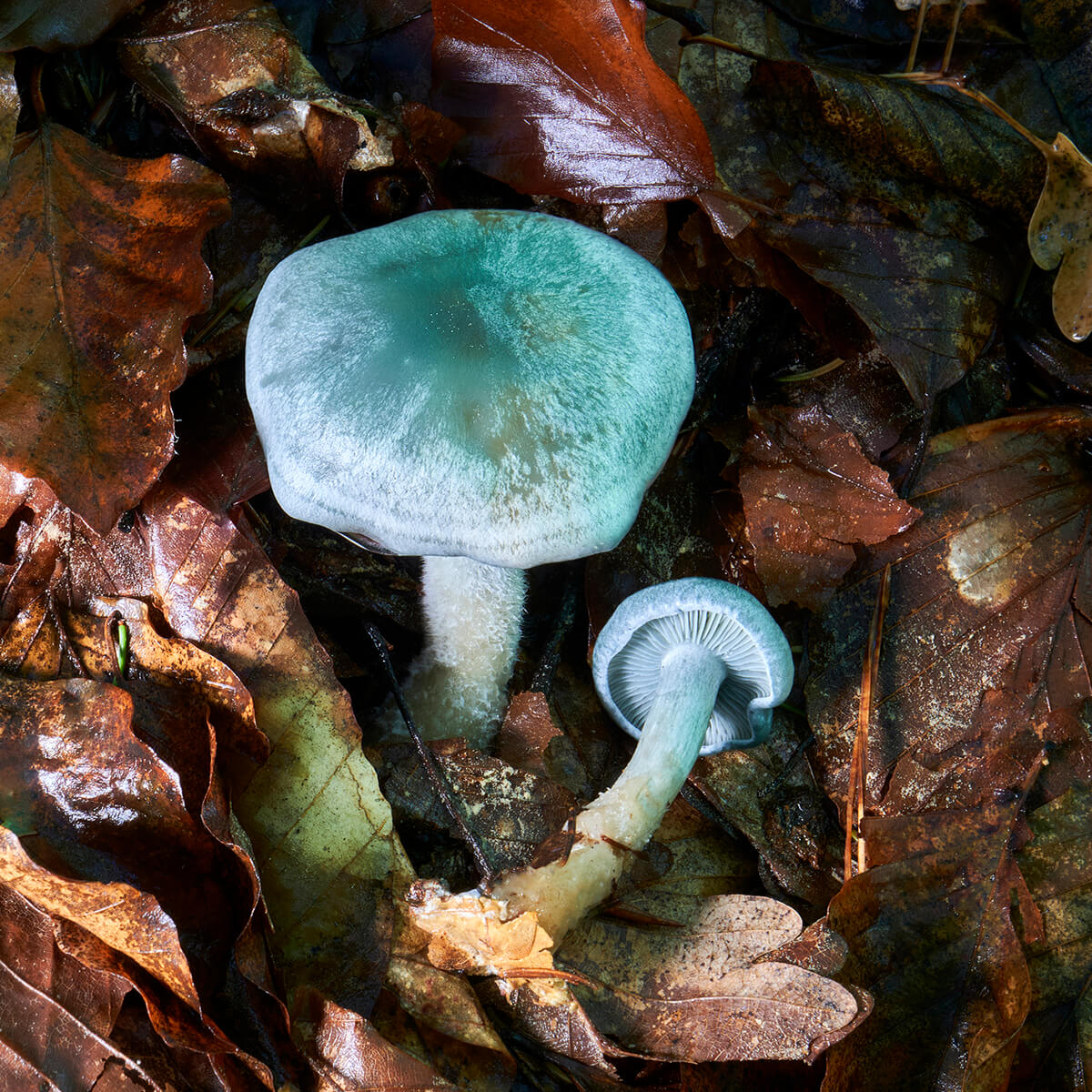
Clitocybe odora, commonly known as the Aniseed Funnel, is a distinctive mushroom recognized primarily by its strong, sweet aniseed scent. It is a saprobic fungus, playing a role in the decomposition of organic matter in woodland ecosystems. Its striking blue-green coloration, though variable, often aids in its identification, especially when combined with its characteristic aroma. While generally considered edible, caution is advised due to potential confusion with toxic look-alikes and individual sensitivities.
How to Identify
- Cap
- The cap ranges from 3 to 10 cm in diameter, initially convex, becoming plano-convex to broadly umbonate, then often depressed or funnel-shaped (infundibuliform) with age. The margin is often inrolled when young, becoming wavy or lobed. The color is highly variable, typically pale blue-green, greenish-gray, or bluish-white, sometimes fading to yellowish-buff or cream, especially in dry conditions or with age. The surface is smooth, dry, and often pruinose (finely powdered) when young.
- Gills
- The gills are adnate to decurrent, crowded, and relatively narrow. Their color is similar to the cap, ranging from pale blue-green to whitish or cream, sometimes with a yellowish tint. They are often slightly waxy in appearance.
- Stem
- The stem is 3 to 8 cm long and 0.5 to 1.5 cm thick, cylindrical or slightly tapering towards the base, sometimes slightly swollen. It is often fibrous, solid, and concolorous with the cap or paler, sometimes with a whitish mycelial base. The surface is smooth or finely fibrillose.
- Flesh
- The flesh is thin, soft, and whitish to pale greenish. It has a strong, distinctive odor of aniseed (licorice) and a mild, pleasant taste, though it should not be consumed raw for identification.
- Fruiting body
- The fruiting body is typically agaricoid, meaning it has a cap, gills, and a stem. It is medium-sized and often has a somewhat funnel-shaped or depressed cap in maturity.
- Habitat
- Clitocybe odora is a saprobic species, growing solitarily or in small groups on leaf litter, woody debris, or soil in deciduous and coniferous woodlands. It shows a preference for rich, humus-laden soils.
Key Facts
- Cap surfaces: Smooth, dry, often pruinose when young
- Growth Form: Solitary to gregarious
- Spore Print: White to pale cream
- Body color: Pale blue-green, greenish-gray, bluish-white (variable, fading to buff)
- Odor: Strong aniseed
- Flesh bruises: Does not bruise significantly
- Height: 3-8 cm
- Cap Diameter: 3-10 cm
- Nutrient gathering: Saprobic
Safe
SafeClitocybe odora is generally considered edible, but it is crucial to be absolutely certain of its identification due to the existence of several toxic look-alikes, particularly other species within the genus Clitocybe and Inocybe. Some individuals may experience mild gastrointestinal upset, especially if consumed in large quantities or if they have a sensitivity. Always cook thoroughly. Never consume raw. If there is any doubt about identification, do not consume.
Quick Check
- Odor: Strong aniseed (licorice)
- Fruiting: Late summer to autumn
- Substrate: Leaf litter, woody debris, soil in woodlands
Where to Find
Europe
Widespread across temperate regions of Europe, particularly common in broadleaf and mixed woodlands.
North America
Found throughout North America, especially in eastern and western forests.
Asia
Reported in parts of Asia, though less extensively documented than in Europe and North America.
Finding Tips
Woodland Exploration
Focus your search in deciduous and coniferous forests, particularly areas with abundant leaf litter and decaying wood. It often grows near oak, beech, and pine trees.
Seasonal Timing
Look for Clitocybe odora from late summer through autumn, with peak fruiting typically occurring in September and October, depending on local climate conditions.
Aroma is Key
The most reliable identification feature is its strong aniseed smell. Gently crush a small piece of the cap or stem to release the aroma. If it doesn't smell distinctly of anise, it's likely not Clitocybe odora.
Color Variation
Be aware that the blue-green color can fade significantly, especially in older specimens or dry weather, appearing more grayish or buff. Always rely on the scent for confirmation.
Similar Species
Verdigris Agaric
Stropharia aeruginosa
Also known as: Blue-green Stropharia
Lilac Fibrecap
Inocybe lilacina
Also known as: Lilac Inocybe
Blue Roundhead
Stropharia caerulea
Also known as: Blue Stropharia
Scientific Classification
- Phylum
- Basidiomycota
- Class
- Agaricomycetes
- Order
- Agaricales
- Family
- Tricholomataceae
- Genus
- Clitocybe
Storage Information
- Max Temperature: 4°C
- Freezing duration: 6 months
- Min Temperature: 0°C
- Refrigeration: 5 days
How to Clean
Gently brush off any debris with a soft brush or damp cloth. Avoid washing under running water, as mushrooms can absorb excess moisture. Trim off any damaged or insect-eaten parts.
Explore Aniseed Funnel
Identify mushrooms anywhere
Free on iOS, Android, and Web. Photo identification, full database, and your personal collection.