
Got a photo? Identify mushrooms instantly with the Mushby app
Open the appDescription
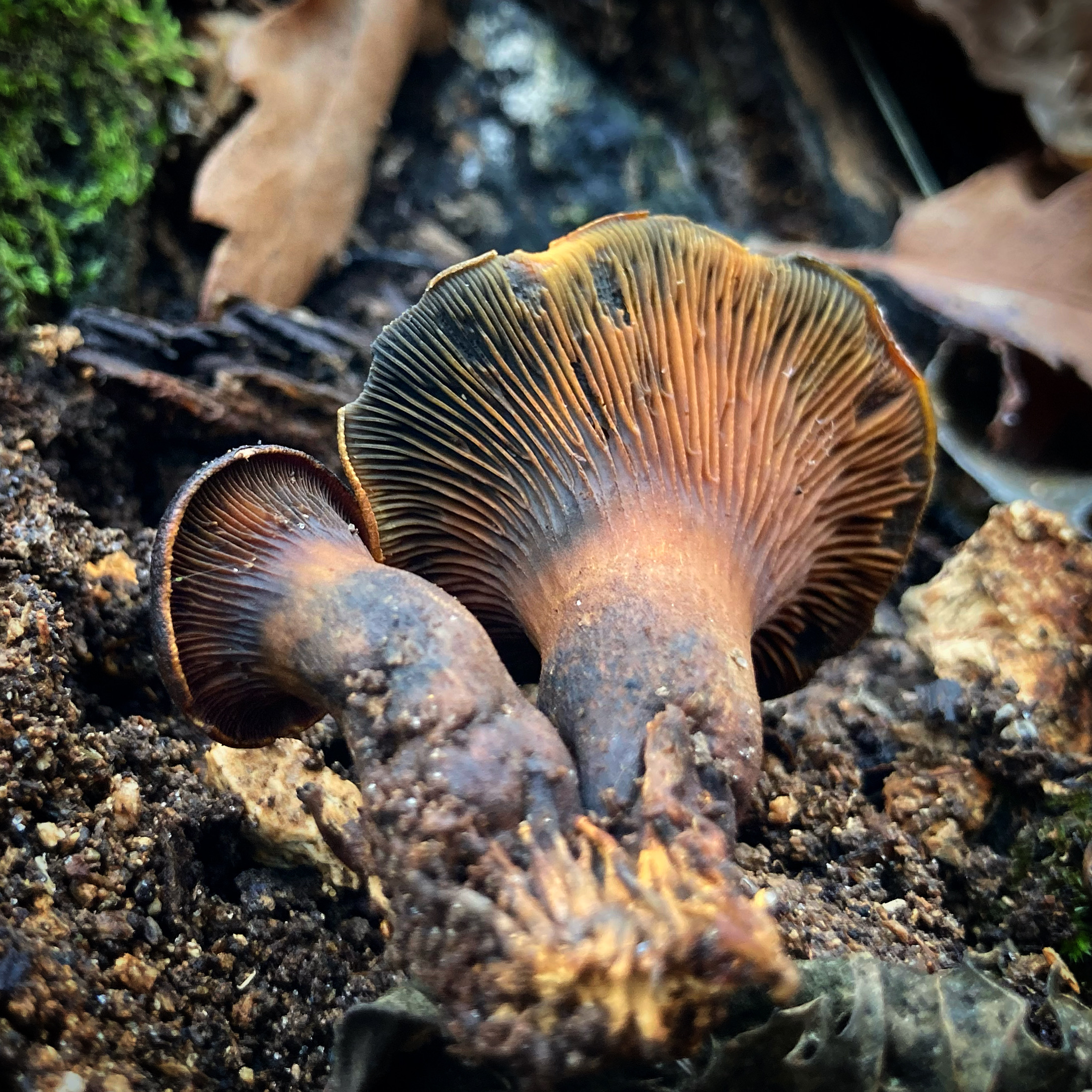
Clitocybe brumalis, commonly known as the Winter Funnel, is a small to medium-sized agaric mushroom characterized by its funnel-shaped cap, decurrent gills, and preference for cold weather. It is typically found fruiting in late autumn and early winter, often after the first frosts, making it a notable species for mycologists and foragers during colder months. Its overall appearance is rather drab, usually in shades of grey, brown, or buff.
How to Identify
- Cap
- The cap of Clitocybe brumalis ranges from 2 to 6 cm in diameter. Initially convex with an inrolled margin, it soon becomes broadly umbilicate or deeply infundibuliform (funnel-shaped) with age. The margin often remains inrolled or becomes wavy. The surface is smooth, dry, and often slightly pruinose (finely powdered) when young. Color varies from grey-brown to buff, sometimes with a slightly darker center, becoming paler towards the margin. It can be somewhat hygrophanous, appearing darker when wet and fading to a lighter color when dry.
- Gills
- The gills are decurrent (running down the stem), crowded, and narrow. They are whitish to pale cream or greyish, sometimes developing a slightly yellowish tint with age. They are often forked near the stem.
- Stem
- The stem is 2 to 5 cm long and 0.3 to 0.8 cm thick, cylindrical or slightly tapering towards the base, sometimes slightly swollen at the base. It is concolorous with the cap or slightly paler, often with a finely fibrillose (fibrous) surface, especially when young. The base may have white mycelial threads. It is solid when young, becoming hollow with age.
- Flesh
- The flesh is thin, soft, and whitish to pale grey. It has a mild taste and a faint, sometimes indistinct, fungoid odor, occasionally described as slightly earthy or mealy.
- Fruiting body
- The fruiting body is a typical agaric mushroom, with a cap, gills, and a central stem. It is generally small to medium-sized.
- Habitat
- Clitocybe brumalis is a saprobic fungus, growing on decaying leaf litter, conifer needles, or woody debris, often in mossy areas. It is typically found in coniferous and mixed woodlands, but can also occur in deciduous forests.
Key Facts
- Cap surfaces: Smooth, dry, often pruinose when young.
- Growth Form: Gregarious, scattered, or in small clusters.
- Spore Print: White to pale cream.
- Body color: Grey-brown to buff, paler towards the margin.
- Odor: Faint, fungoid, sometimes slightly earthy or mealy.
- Flesh bruises: Does not bruise.
- Height: 2-5 cm
- Cap Diameter: 2-6 cm
- Nutrient gathering: Saprobic
Safe
DeadlyClitocybe brumalis is generally considered edible, but it is not highly regarded due to its small size and thin flesh. It is important to exercise extreme caution due to the presence of several highly toxic look-alikes within the Clitocybe genus, particularly Clitocybe dealbata and Clitocybe rivulosa, which contain muscarine. Misidentification can lead to severe poisoning. Therefore, it is not recommended for consumption by inexperienced foragers.
Quick Check
- Odor: Faint, fungoid, sometimes slightly earthy or mealy, not distinctive.
- Fruiting: Late autumn to early winter.
- Substrate: Decaying leaf litter, conifer needles, woody debris.
Where to Find
Europe
Widespread across temperate regions of Europe, particularly in northern and central parts.
North America
Common in coniferous and mixed forests across North America, especially in colder regions.
Asia
Reported in parts of Asia with similar temperate climates.
Finding Tips
Seasonal Timing
Look for Clitocybe brumalis from late autumn through early winter, often after the first hard frosts. It can persist into periods of mild winter weather.
Habitat Preference
Search in coniferous or mixed woodlands, particularly among leaf litter, conifer needles, or on well-rotted wood. Mossy areas are often productive.
Growth Pattern
It typically grows gregariously, often in scattered groups or sometimes in small clusters.
Distinguishing Features
Pay attention to the funnel-shaped cap, decurrent gills, and the overall greyish-brown coloration. The lack of a strong distinctive odor is also a key feature.
Similar Species
Clouded Funnel
Clitocybe
Also known as: Clitocybe nebularis
Ivory Funnel
Clitocybe
Also known as: Clitocybe dealbata
Trooping Funnel
Clitocybe
Also known as: Clitocybe geotropa
Aniseed Funnel
Clitocybe
Also known as: Clitocybe odora
Scientific Classification
- Phylum
- Basidiomycota
- Class
- Agaricomycetes
- Order
- Agaricales
- Family
- Tricholomataceae
- Genus
- Clitocybe
Storage Information
- Max Temperature: 4°C
- Freezing duration: 6 months
- Min Temperature: 1°C
- Refrigeration: 5 days
How to Clean
Gently brush off any debris or soil with a soft brush or damp cloth. Avoid washing under running water as mushrooms can absorb excess moisture. If necessary, a quick rinse and immediate drying are acceptable.
Explore Winter Funnel
Identify mushrooms anywhere
Free on iOS, Android, and Web. Photo identification, full database, and your personal collection.