
Got a photo? Identify mushrooms instantly with the Mushby app
Open the appDescription
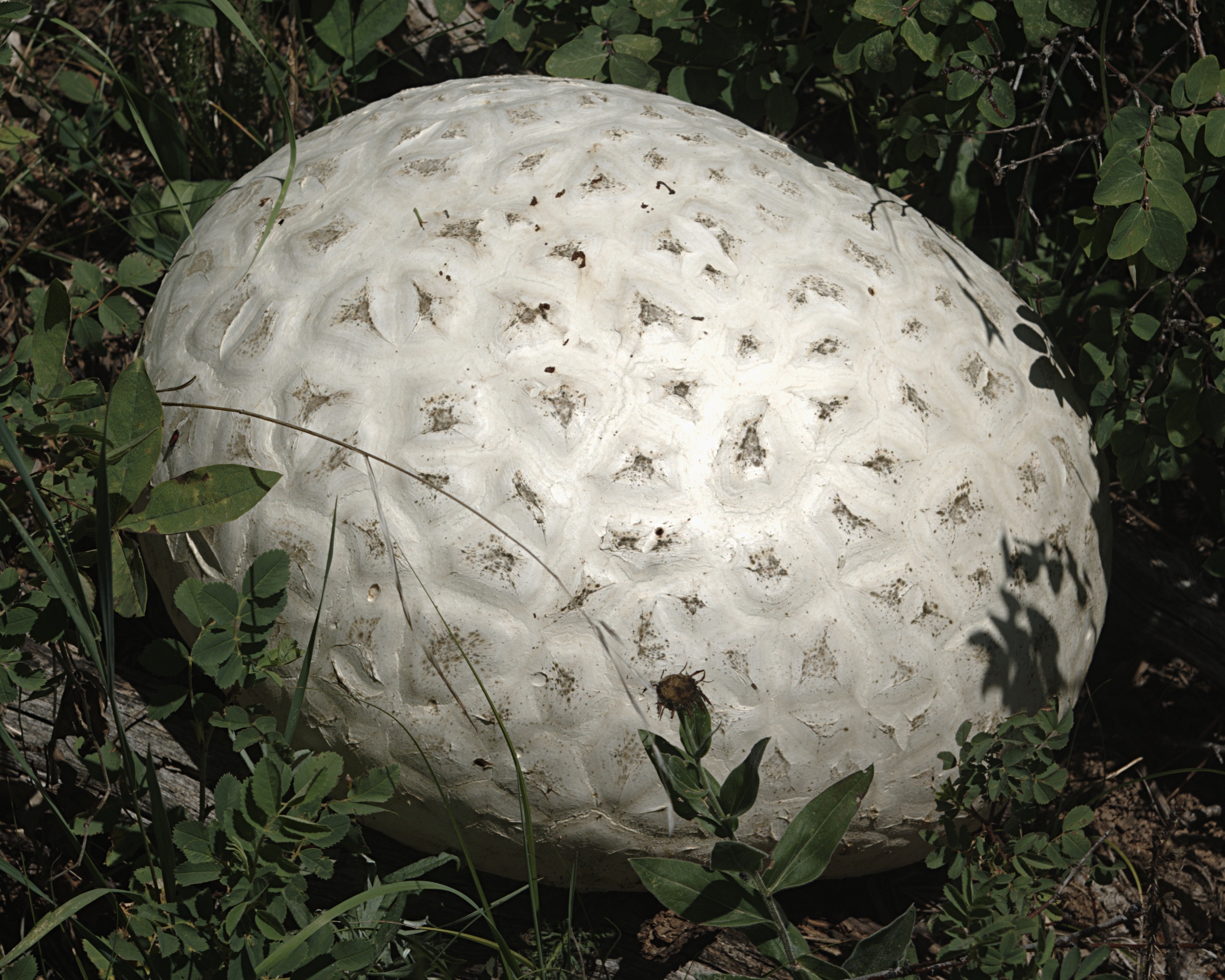
A large, spherical to sub-spherical saprobic fungus found in the Western United States. It possesses a thick, scaly or cracked outer skin (exoperidium) that eventually breaks down to expose a massive internal mass of gleba.
How to Identify
- Cap
- Surface is initially white to tan, covered in thick, coarse, polygonal scales that crack as the mushroom matures.
- Gills
- None, as it is a gasteroid fungus.
- Stem
- Absent or represented by a sterile, thick, root-like mycelial base.
- Flesh
- Uniformly pure white and firm (glaebal) in youth; becomes yellowish-olive and powdery as it matures into spores.
- Fruiting body
- Large, rounded fruiting body, often reaching 15-60 cm in diameter.
- Habitat
- Typically found in arid or semi-arid regions, grassy fields, sagebrush steppes, and occasionally edges of coniferous forests.
Key Facts
- Cap surfaces: Thick, scaly, and cracked into polygonal patterns
- Growth Form: Solitary or small groups
- Spore Print: Olive-brown or yellowish-brown
- Body color: White to brownish-tan
- Odor: Faint, pleasant mushroom scent
- Flesh bruises: Does not change color significantly
- Height: 10-30 cm
- Cap Diameter: 15-60 cm
- Nutrient gathering: Saprobic (decomposing organic matter in soil)
Safe
SafeEdible only while the interior is firm and purely white. If the interior shows any signs of yellowing or browning, it is over-mature and can cause severe gastrointestinal upset. Always check for immature stages of Amanita mushrooms (the 'egg' stage) growing nearby, which can be fatal if misidentified.
Quick Check
- Odor: Mild and pleasant, often described as having a mushroomy scent.
- Fruiting: Occurs singly or in small, scattered groups.
- Substrate: Typically soil or sandy ground in sagebrush or grasslands.
Where to Find
Western North America
Commonly found in states like Idaho, Montana, Oregon, and Washington in high desert or transition zones.
Finding Tips
Seasonality
Look for them from late summer through early autumn, particularly after heavy rains in dry regions.
Substrate
Search in open, sunny areas or partially shaded patches in sagebrush scrub, as they are saprobic and prefer open ground.
Similar Species
Giant Puffball
Calvatia gigantea
Also known as: Langermannia gigantea
Western Giant Puffball Look-alike
Calvatia sculpta
Also known as: Sculptured Puffball
Earthball
Scleroderma species
Also known as: False Puffball
Scientific Classification
- Phylum
- Basidiomycota
- Class
- Agaricomycetes
- Order
- Agaricales
- Family
- Agaricaceae
- Genus
- Calvatia
Storage Information
- Max Temperature: 4 degrees Celsius
- Freezing duration: Up to 6 months
- Min Temperature: 1 degree Celsius
- Refrigeration: Up to 3 days
How to Clean
Gently brush off soil and debris from the exterior. If the skin is very thick or dirty, peel off the outer peridium layer with a knife before processing.
Explore Western Giant Puffball
Identify mushrooms anywhere
Free on iOS, Android, and Web. Photo identification, full database, and your personal collection.