
Got a photo? Identify mushrooms instantly with the Mushby app
Open the appDescription
Calocera cornea, commonly known as the Small Staghorn or Club Coral, is a distinctive jelly fungus belonging to the Dacrymycetales order. It is characterized by its bright yellow to orange, upright, unbranched or sparsely branched, gelatinous fruiting bodies that resemble small antlers or clubs. This saprobic fungus plays an important role in forest ecosystems by decomposing dead woody material, particularly deciduous hardwoods. Although it is widespread and common, its small size often means it is overlooked by casual observers.
How to Identify
- Cap
- N/A (no distinct cap)
- Gills
- N/A (not a gilled mushroom)
- Stem
- N/A (the entire fruiting body is stalk-like, attached directly to the substrate by a slightly constricted base)
- Flesh
- The flesh is concolorous with the outer surface, gelatinous and resilient.
- Fruiting body
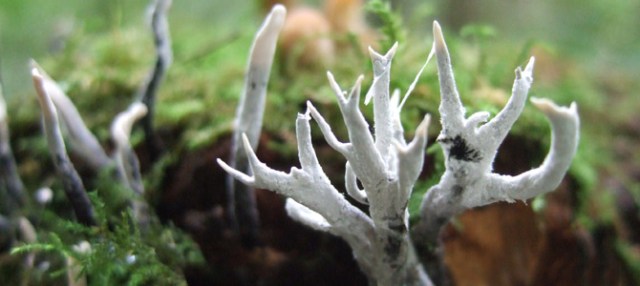
- The fruiting bodies are typically 0.5 to 2 cm (0.2 to 0.8 inches) tall, and 0.5 to 3 mm wide, usually unbranched or with one or two small, antler-like tips. They are bright yellow to orange-yellow, becoming slightly paler with age. The texture is gelatinous and rubbery when moist, becoming hard and brittle when dry. They are smooth and cylindrical to somewhat flattened.
- Habitat
- Saprobic, growing on dead deciduous wood, especially logs, fallen branches, and stumps. Often found on decorticated (barkless) wood.
Key Facts
- Cap surfaces: N/A
- Growth Form: Club-like to sparsely branched, solitary or gregarious
- Spore Print: White to pale yellow (spores are pale yellow in mass)
- Body color: Bright yellow to orange-yellow
- Odor: Indistinct
- Flesh bruises: Does not bruise
- Height: 0.5 - 2 cm (0.2 - 0.8 inches)
- Cap Diameter: N/A
- Nutrient gathering: Saprobic
Safe
SafeCalocera cornea is generally considered edible, though it is not typically consumed due to its small size, rubbery texture, and lack of significant flavor or substance. It is not known to be toxic. However, as with all wild edibles, proper identification is crucial. There are no known toxic look-alikes that resemble it closely and are likely to cause severe harm.
Quick Check
- Odor: Indistinct or mild
- Fruiting: Year-round in mild climates; most common late spring to autumn
- Substrate: Dead deciduous wood
Where to Find
Broadleaf forests
Commonly found in broadleaf or mixed deciduous forests where there is an abundance of dead hardwood. Look for it on logs and branches.
Coniferous forests (less common)
While primarily found on deciduous wood, it can occasionally be seen on conifer debris, though this is less typical.
Woodlands
Any woodland area with decaying hardwood material presents a potential habitat.
Finding Tips
Look closely on dead wood
Due to its small size, Calocera cornea is easily overlooked. Carefully inspect dead logs, branches, and stumps, particularly those that are well-rotted and barkless. Its bright color often helps it stand out against the darker wood.
Habitat preference
Focus your search on deciduous wood. It isn't typically found growing directly from soil or living trees.
Seasonal timing
While it can be found throughout the year in mild climates, it is most prominent during moist periods, typically from late spring through autumn, and often persisting through mild winters.
Similar Species
Staghorn Jelly
fungus
Also known as: Yellow Tuning Fork, Finger-like Staghorn Jelly
Candle Snuff Fungus
fungus
Also known as: Carbon Antlers
Yellow Reindeer Club
fungus
Also known as: Yellow Club Fungus
Scientific Classification
- Phylum
- Basidiomycota
- Class
- Dacrymycetes
- Order
- Dacrymycetales
- Family
- Dacrymycetaceae
- Genus
- Calocera
Storage Information
- Max Temperature: N/A
- Freezing duration: N/A
- Min Temperature: N/A
- Refrigeration: N/A
How to Clean
Not relevant for consumption. If for observation or photography, simply brushing off loose debris with a soft brush would suffice.
Explore Small Staghorn
Identify mushrooms anywhere
Free on iOS, Android, and Web. Photo identification, full database, and your personal collection.