
Got a photo? Identify mushrooms instantly with the Mushby app
Open the appDescription
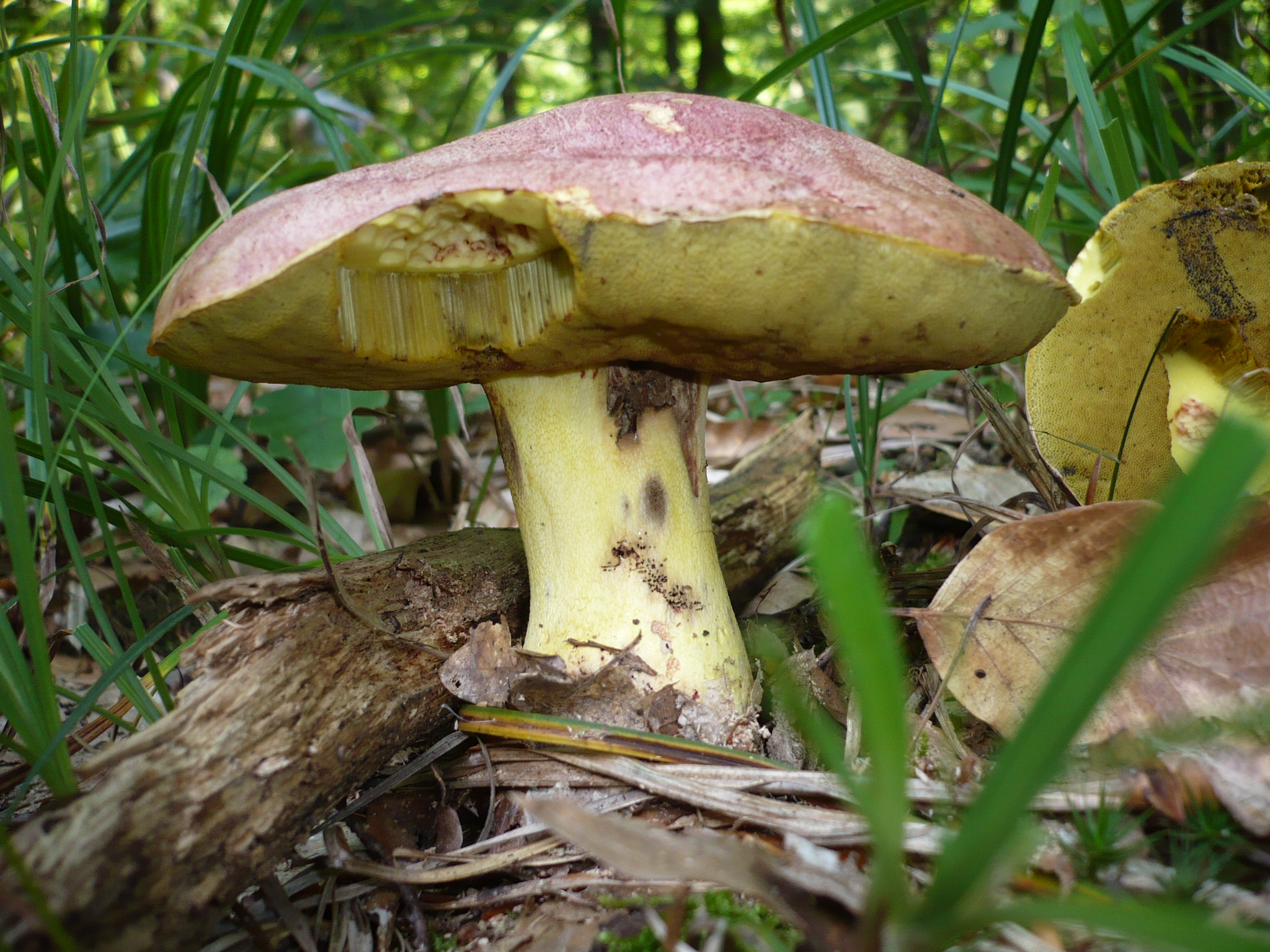
Butyriboletus regius, commonly known as the royal bolete or butter bolete, is a rare and edible bolete mushroom. It is distinguished by its bright yellow to reddish-pink cap and yellow pores. It is found in deciduous forests, particularly under oak and beech trees.
How to Identify
- Cap
- The cap is convex, becoming more flattened with age. It is typically 5–15 cm in diameter. The color is usually bright yellow, but can also be reddish-pink or orange-yellow. The surface is smooth and dry, and may be slightly sticky when wet.
- Gills
- Butyriboletus regius is a bolete, so it has pores instead of gills. The pores are small and round, and bright yellow, bruising blue when handled.
- Stem
- The stem is stout and club-shaped, typically 5–12 cm long and 2–5 cm thick. It is yellow, often with a reddish tint, and may have a fine network of ridges near the top.
- Flesh
- The flesh is thick and yellow. It may stain slightly blue when cut, particularly in the stem.
- Fruiting body
- The fruit body of Butyriboletus regius is a typical bolete shape, with a cap and a central stem. It is medium to large in size.
- Habitat
- This mushroom is found in deciduous forests, particularly under oak and beech trees. It is a mycorrhizal fungus, forming a symbiotic relationship with the roots of trees.
Key Facts
- Cap surfaces: Smooth, dry, may be slightly sticky when wet
- Growth Form: Mycorrhizal
- Spore Print: Olive-brown
- Body color: Yellow, reddish-pink, or orange-yellow
- Odor: Mild and pleasant
- Flesh bruises: May stain slightly blue when cut
- Height: 5-12 cm
- Cap Diameter: 5-15 cm
- Nutrient gathering: Mycorrhizal
Safe
SafeButyriboletus regius is considered an edible mushroom, but it is rare and should be positively identified before consumption. Some individuals may experience gastrointestinal upset.
Quick Check
- Odor: Mild and pleasant
- Fruiting: Summer to fall
- Substrate: Soil under deciduous trees
Where to Find
North America
Eastern North America, particularly the southeastern United States.
Europe
Southern Europe, including Italy and France.
Finding Tips
Look under oak and beech trees
Butyriboletus regius is often found in association with these trees.
Search in deciduous forests
This mushroom prefers deciduous forests with well-drained soil.
Check in summer and fall
The fruiting season is typically from summer to fall.
Similar Species
Boletus sensibilis
a bolete mushroom
Also known as: The sensitive bolete
Scientific Classification
- Phylum
- Basidiomycota
- Class
- Agaricomycetes
- Order
- Boletales
- Family
- Boletaceae
- Genus
- Butyriboletus
Storage Information
- Max Temperature: 20
- Freezing duration: 3 months
- Min Temperature: 2
- Refrigeration: 3 days
How to Clean
Clean the mushroom by brushing off any dirt or debris. Avoid washing it unless necessary, as it can become waterlogged. If washing is needed, do so quickly and pat dry.
Explore Sulphur Bolete
Identify mushrooms anywhere
Free on iOS, Android, and Web. Photo identification, full database, and your personal collection.