
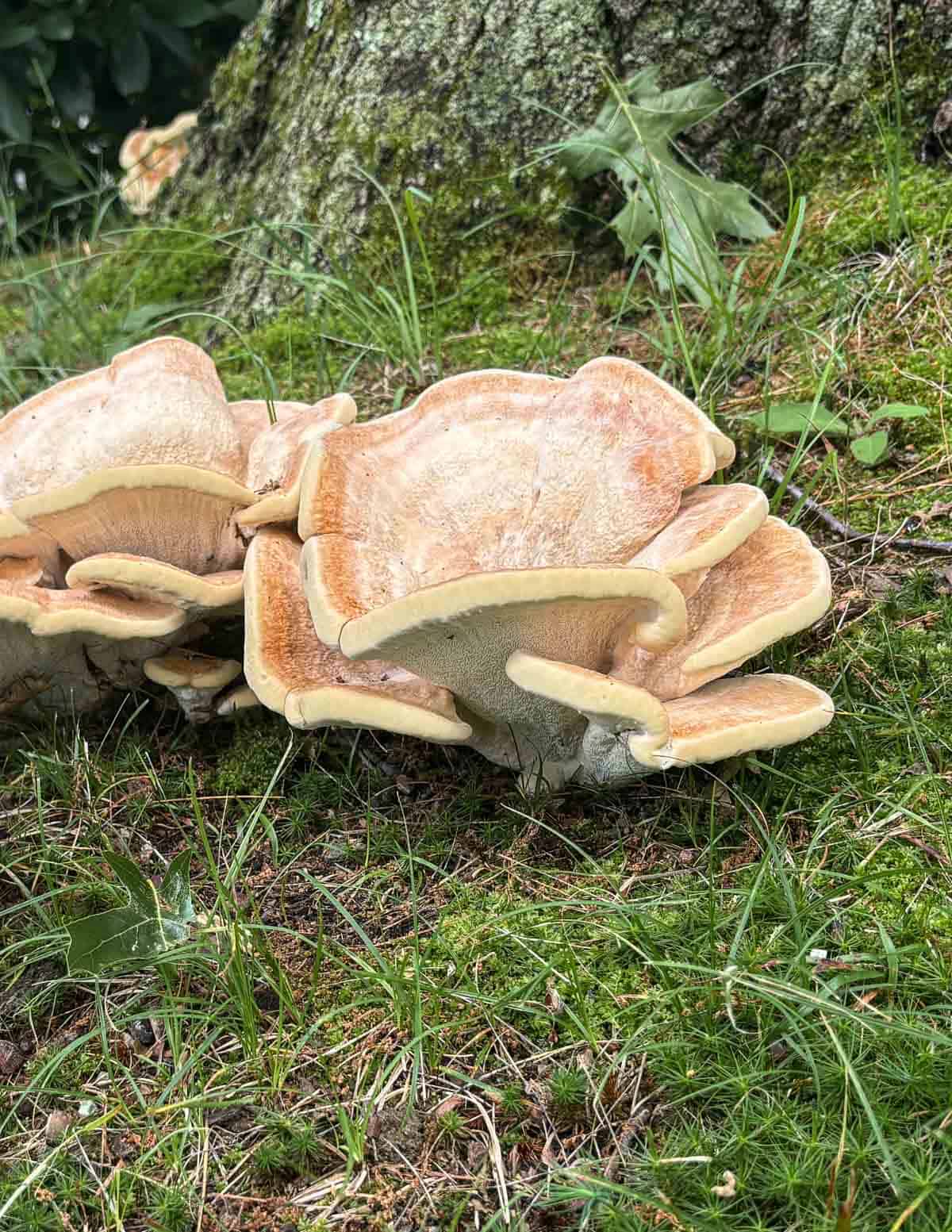
How to identify Berkeley's Polypore
Bondarzewia berkeleyi
Got a photo? Identify mushrooms instantly with the Mushby app
Open the appTo correctly identify Berkeley's Polypore (Bondarzewia berkeleyi), check each of these features in order. Misidentification is the most common cause of mushroom poisoning, so cross-reference multiple sources.
Step-by-step identification
- 1
Cap
Shape, color, surface texture, and diameter.
Large, shelf-like, cream to tan, rough and uneven surface.
- 2
Gills
Attachment to stem, color, and spacing.
Absent; underside features closely packed pores.
- 3
Stem
Length, shape, surface, and any ring.
Sessile or with a very short, thick stem.
- 4
Flesh
Color, texture, and bruising reaction.
Thick and tough, especially in older specimens.
- 5
Fruiting body
Overall growth pattern.
Large, often several feet in diameter, growing in clusters or as individual shelves.
- 6
Habitat
Where it grows and on what substrate.
Base of oak trees or on their roots.
Key Facts
- Cap surfaces
- Rough, uneven
- Growth Form
- Shelf-like, clustered
- Spore Print
- White
- Body color
- Cream to tan
- Odor
- Mild, mushroomy
- Flesh bruises
- No significant bruising
- Height
- Up to 1 foot
- Cap Diameter
- Up to 3 feet or more
Fruit body characteristics
- Gill attachment: N/A (pores instead of gills)
- Stem shape: N/A (sessile or with a very short stem)
- Stem surface: N/A (sessile or with a very short stem)
- Ring: Absent
- Stem cross-section: N/A (sessile or with a very short stem)
Explore Berkeley's Polypore
Identify mushrooms anywhere
Free on iOS, Android, and Web. Photo identification, full database, and your personal collection.