
Got a photo? Identify mushrooms instantly with the Mushby app
Open the appDescription
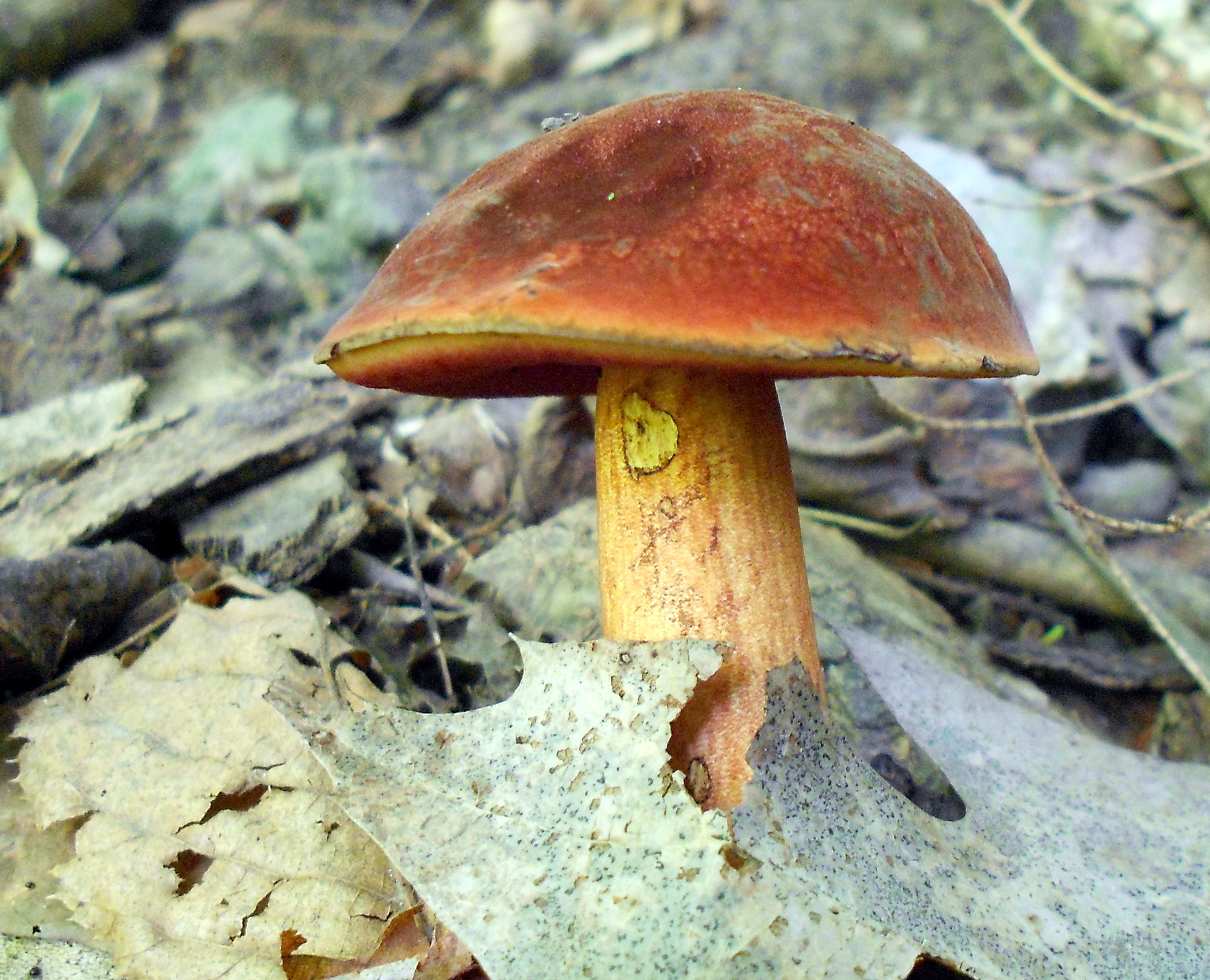
Boletus subvelutipes is a robust bolete characterized by its velvety to finely tomentose cap, typically reddish-brown to olive-brown, and its striking red to orange-red pore surface that instantly bruises dark blue to black upon handling. The stem is often yellow at the apex, becoming reddish towards the base, and can be smooth or finely reticulate. Its flesh is yellowish and also stains blue when cut or bruised. This species is known for its strong bluing reaction, which is a key identification feature.
How to Identify
- Cap
- The cap is 5-15 cm (2-6 inches) in diameter, convex to broadly convex, becoming nearly flat with age. The surface is dry, velvety to finely tomentose, sometimes becoming smooth. Color ranges from reddish-brown, dark brown, olive-brown, to sometimes yellowish-brown. It bruises dark blue to black when handled.
- Gills
- This mushroom has pores, not gills. The pore surface is initially yellow, quickly becoming orange-red to deep red, especially towards the margin. The pores are small and circular. They bruise dark blue to black instantly and intensely upon touch.
- Stem
- The stem is 5-15 cm (2-6 inches) long and 1-3 cm (0.4-1.2 inches) thick, typically stout and solid. It is often yellow at the apex, becoming reddish or brownish towards the base. The surface can be smooth, finely pruinose, or sometimes with a fine, reddish reticulum (net-like pattern) near the apex, though this is often faint or absent. It bruises blue to black.
- Flesh
- The flesh is thick, firm, and yellowish, especially in the cap. It stains dark blue instantly and intensely when cut or bruised, particularly in the cap and upper stem.
- Fruiting body
- The fruiting body is a typical bolete shape, robust and fleshy, with a distinct cap, pore surface, and stem.
- Habitat
- Solitary to scattered or gregarious on the ground in deciduous and mixed forests, often associated with oak (Quercus) and sometimes other hardwoods or conifers.
Key Facts
- Cap surfaces: Velvety to finely tomentose, dry.
- Growth Form: Solitary to scattered or gregarious.
- Spore Print: Olive-brown to brownish-olive.
- Body color: Cap reddish-brown to olive-brown; pores red to orange-red; stem yellow to reddish; flesh yellowish.
- Odor: Mild.
- Flesh bruises: Instantly and intensely dark blue to black.
- Height: 5-15 cm (2-6 inches)
- Cap Diameter: 5-15 cm (2-6 inches)
- Nutrient gathering: Mycorrhizal
Toxic
Severe ToxicityBoletus subvelutipes is considered toxic when consumed raw or insufficiently cooked, and especially when consumed with alcohol. It can cause gastrointestinal upset, including nausea, vomiting, and diarrhea. The exact toxic compounds are not fully understood, but it is known to contain compounds that can interact negatively with alcohol, similar to Coprinopsis atramentaria (Inky Cap).
Quick Check
- Odor: Mild, not distinctive.
- Fruiting: Summer to early autumn.
- Substrate: Ground, mycorrhizal with hardwoods, especially oak.
Where to Find
Eastern North America
Common throughout eastern North America, extending from Canada south to Florida and west to the Great Plains.
Deciduous and Mixed Forests
Typically found in woodlands dominated by oak (Quercus) species, but can also occur with other hardwoods like beech (Fagus) and sometimes conifers.
Finding Tips
Look for Oak Trees
Focus your search in areas with mature oak trees, as Boletus subvelutipes forms mycorrhizal associations with them.
Check for Bluing Reaction
A key identifier is the rapid and intense dark blue to black staining of the pores and flesh when bruised or cut. This is a crucial diagnostic feature.
Observe Pore Color
The red to orange-red pore surface is distinctive. Ensure it's not merely yellow or olive, which would suggest other species.
Seasonal Foraging
This species typically fruits from summer through early autumn, peaking in late summer after periods of rain.
Similar Species
Two-colored Bolete
Baorangia bicolor
Also known as: Red and Yellow Bolete
Bitter Bolete
Tylopilus felleus
Also known as: Bitter Tylopilus
Lurid Bolete
Suillellus luridus
Also known as: Scarlet-stemmed Bolete
Bicolor Bolete
Boletus bicolor
Also known as: Red and Yellow Bolete
Scientific Classification
- Phylum
- Basidiomycota
- Class
- Agaricomycetes
- Order
- Boletales
- Family
- Boletaceae
- Genus
- Boletus
Explore Red-mouthed Bolete
Identify mushrooms anywhere
Free on iOS, Android, and Web. Photo identification, full database, and your personal collection.