
Got a photo? Identify mushrooms instantly with the Mushby app
Open the appDescription
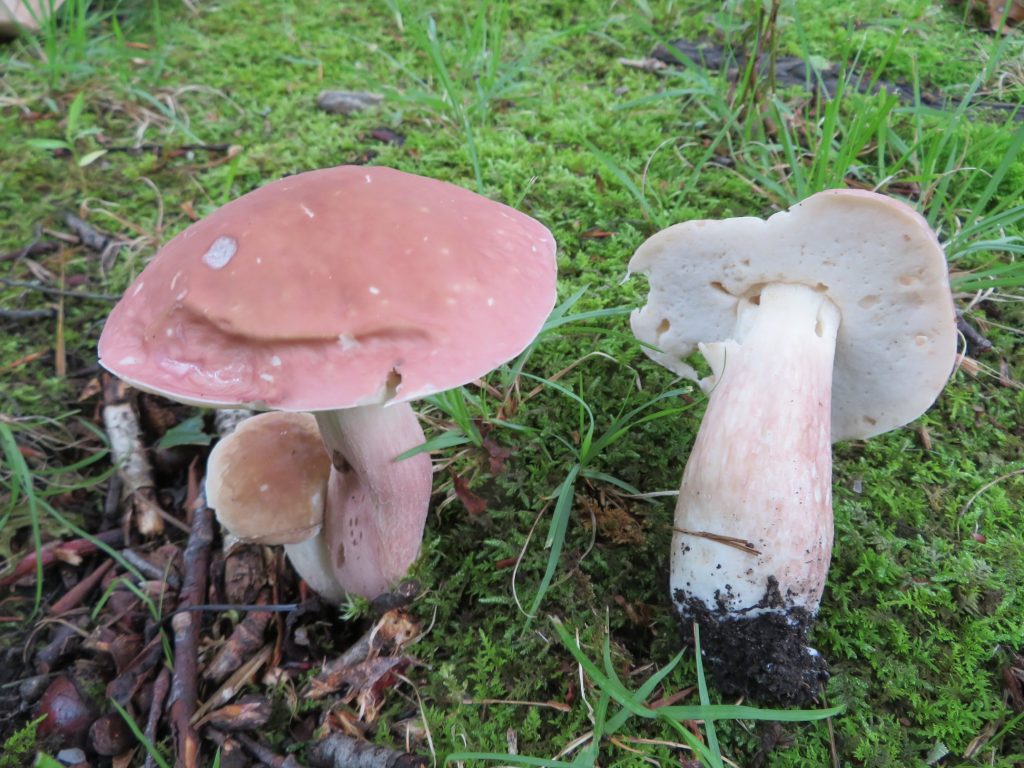
Boletus separans, commonly known as the Lilac Bolete, is a mycorrhizal fungus that forms symbiotic relationships with trees. It is characterized by its distinctive lilac to reddish-brown cap and yellowish pores. The mushroom is edible, but caution is advised due to potential confusion with other bolete species.
How to Identify
- Cap
- The cap is convex, later flattening out, and ranges from lilac to reddish-brown. The surface is dry and may be slightly velvety.
- Gills
- Boletes do not have gills; instead, they have pores. The pores of Boletus separans are yellowish, bruising blue when handled.
- Stem
- The stem is stout, often club-shaped, and colored similarly to the cap or slightly lighter. It may have a fine network of ridges (reticulation) near the top.
- Flesh
- The flesh is firm and white, sometimes staining slightly blue when cut.
- Fruiting body
- The fruiting body of Boletus separans is a typical bolete shape, with a cap and a central stem.
- Habitat
- This bolete is found in deciduous and coniferous forests, forming mycorrhizal associations with trees.
Key Facts
- Cap surfaces: Dry, slightly velvety
- Growth Form: Mycorrhizal
- Spore Print: Olive-brown
- Body color: Lilac to reddish-brown
- Odor: Mild
- Flesh bruises: Sometimes slightly blue
- Height: 5-15 cm
- Cap Diameter: 5-20 cm
- Nutrient gathering: Mycorrhizal
Safe
SafeBoletus separans is generally considered edible, but caution is advised. Some individuals may experience gastrointestinal upset. It is crucial to avoid confusing it with toxic look-alikes.
Quick Check
- Odor: Mild and pleasant
- Fruiting: Summer to autumn
- Substrate: Soil, mycorrhizal with trees
Where to Find
Europe
Found in various European countries.
North America
Occurs in eastern North America.
Finding Tips
Look near host trees
Search for Boletus separans near oak, beech, and pine trees, as it forms mycorrhizal relationships with them.
Check well-drained soils
This bolete prefers well-drained soils in wooded areas.
Similar Species
Bitter Bolete
a bolete mushroom
Also known as: Tylopilus felleus
Scientific Classification
- Phylum
- Basidiomycota
- Class
- Agaricomycetes
- Order
- Boletales
- Family
- Boletaceae
- Genus
- Boletus
Storage Information
- Max Temperature: 20
- Freezing duration: 6 months
- Min Temperature: 2
- Refrigeration: 3 days
How to Clean
Clean Boletus separans by brushing off any dirt or debris. Avoid washing unless necessary, as boletes can become waterlogged. Trim the stem if needed.
Explore Lilac Bolete
Identify mushrooms anywhere
Free on iOS, Android, and Web. Photo identification, full database, and your personal collection.