
Got a photo? Identify mushrooms instantly with the Mushby app
Open the appDescription
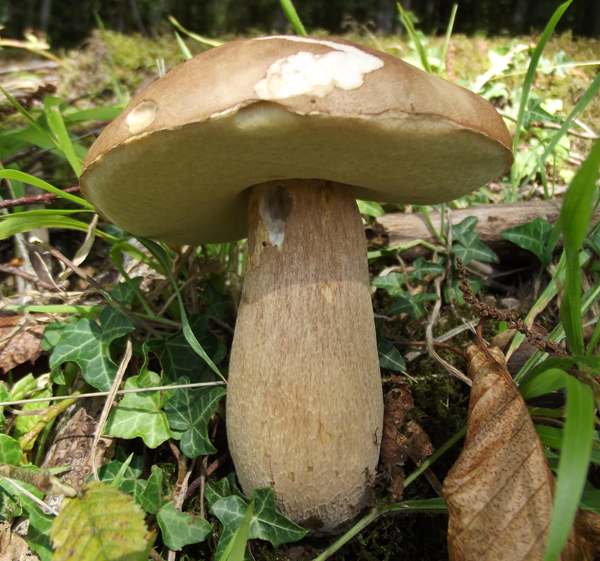
Boletus reticulatus, commonly known as the Summer Bolete or Oak Bolete, is a highly prized edible mushroom belonging to the family Boletaceae. It is closely related to the more widely known Porcini (Boletus edulis) and shares many of its culinary attributes. This species is characterized by its reticulated (net-like) stem and often cracked, velvety cap, particularly in dry weather. It typically fruits earlier in the season than other porcini species, hence its common name.
How to Identify
- Cap
- The cap is typically 6-20 cm (2.4-7.9 inches) in diameter, convex to broadly convex, becoming flatter with age. The color ranges from light brown to reddish-brown, sometimes with ochre or yellowish tones. The surface is dry, velvety or finely tomentose, and often develops a distinctive network of cracks (reticulations) in dry conditions, revealing lighter flesh beneath. The margin is usually incurved when young, becoming decurved to wavy with age.
- Gills
- Instead of gills, Boletus reticulatus has a pore surface. The pores are small, circular, and initially white or whitish, becoming yellowish-green to olive-brown with age. They do not stain blue when bruised. The tubes are long and white, becoming yellowish-green.
- Stem
- The stem is stout and robust, 5-15 cm (2-5.9 inches) long and 2-6 cm (0.8-2.4 inches) thick, often swollen or club-shaped when young, becoming more cylindrical with age. The color is whitish to pale brown, covered with a prominent, raised, white to brownish reticulation (net-like pattern) that extends from the apex down to at least the middle, and often to the base. The base of the stem can be slightly darker.
- Flesh
- The flesh is thick, firm, and white, remaining white when cut or bruised. It has a pleasant, mild, nutty taste and a faint, agreeable mushroomy odor.
- Fruiting body
- The fruiting body is robust and fleshy, typical of a bolete. It can grow quite large, often reaching 20 cm or more in cap diameter.
- Habitat
- Boletus reticulatus is a mycorrhizal fungus, forming symbiotic relationships primarily with deciduous trees, especially oak (Quercus spp.), but also beech (Fagus spp.), hornbeam (Carpinus spp.), and sometimes chestnut (Castanea spp.). It grows solitarily or in scattered groups on the ground in broadleaf forests.
Key Facts
- Cap surfaces: Dry, velvety, often cracked (reticulated) in dry weather
- Growth Form: Solitary to scattered
- Spore Print: Olive-brown
- Body color: Cap: light brown to reddish-brown; Stem: whitish to pale brown with white reticulation; Pores: white to yellowish-green
- Odor: Mild, pleasant
- Flesh bruises: Does not stain or bruise blue
- Height: 5-15 cm (2-5.9 inches)
- Cap Diameter: 6-20 cm (2.4-7.9 inches)
- Nutrient gathering: Mycorrhizal
Safe
SafeBoletus reticulatus is a highly prized edible mushroom. There are no known toxic look-alikes that would cause severe poisoning if mistaken for it, but some bitter boletes (e.g., Tylopilus felleus) can ruin a meal. Always be 100% certain of identification before consumption. Raw consumption is not recommended as it can cause mild gastrointestinal upset in some individuals; always cook thoroughly.
Quick Check
- Odor: Mild, pleasant, mushroomy
- Fruiting: Late spring to early autumn
- Substrate: Ground, mycorrhizal with broadleaf trees (oaks, beeches)
Where to Find
Europe
Widespread across Europe, particularly in central and southern regions. Common in oak and beech forests.
North America
While often reported, its presence in North America is debated, with many similar species being misidentified. True Boletus reticulatus is primarily a European species, though closely related species exist in North America.
Finding Tips
Seasonality
Typically fruits from late spring through summer, often earlier than Boletus edulis, especially after warm, humid periods following rain. Can extend into early autumn in favorable conditions.
Habitat Preference
Look for it in mature broadleaf woodlands, particularly under oak and beech trees. It prefers well-drained, often calcareous soils.
Identification
Key features are the velvety, often cracked cap, the prominent white reticulation on the stem, and the unchanging white flesh and pores. Always check for insect larvae, as boletes are often heavily infested.
Similar Species
Porcini
Boletus
Also known as: King Bolete, Penny Bun
Bitter Bolete
Tylopilus
Also known as: Bitter Pores
Bay Bolete
Imleria
Also known as: Bay Brown Bolete
Scientific Classification
- Phylum
- Basidiomycota
- Class
- Agaricomycetes
- Order
- Boletales
- Family
- Boletaceae
- Genus
- Boletus
Storage Information
- Max Temperature: 4°C
- Freezing duration: 6 months
- Min Temperature: 0°C
- Refrigeration: 5 days
How to Clean
Gently brush off any dirt or debris with a soft brush or damp cloth. Avoid washing under running water, as boletes absorb water readily, which can make them soggy. Trim off any insect-damaged parts.
Explore Summer Bolete
Identify mushrooms anywhere
Free on iOS, Android, and Web. Photo identification, full database, and your personal collection.