
Got a photo? Identify mushrooms instantly with the Mushby app
Open the appDescription
The Blue-staining Bolete, also known as Boletus pulverulentus, is a common edible mushroom that is found in North America. It is characterized by its blue-staining flesh and its distinctive cap, which can be either brown or reddish-brown. The Blue-staining Bolete is a popular choice for mushroom hunters, as it is relatively easy to identify and is considered to be a good edible mushroom. However, it is important to note that some people may experience allergic reactions to this mushroom, so it is always best to err on the side of caution and consult with a qualified mycologist before consuming any wild mushrooms.
How to Identify
- Cap
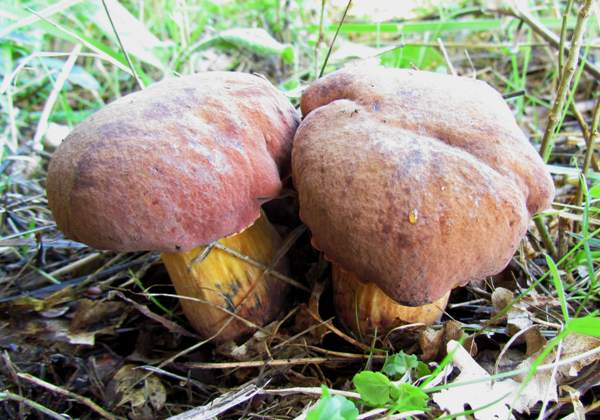
- The cap of the Blue-staining Bolete is typically 5-15 cm in diameter. It is convex when young and becomes flat or slightly depressed as it matures. The cap is often covered in a thin layer of white powder, which can be easily brushed off. The cap color can vary from brown to reddish-brown.
- Gills
- The Blue-staining Bolete does not have gills. Instead, it has pores on the underside of the cap. The pores are small and round, and they are white when young and become yellow or olive-brown as they mature.
- Stem
- The stem of the Blue-staining Bolete is typically 5-10 cm long and 2-4 cm thick. It is club-shaped and is often covered in a thin layer of white powder. The stem color can vary from white to yellow to brown.
- Flesh
- The flesh of the Blue-staining Bolete is white when fresh, but it quickly turns blue when cut or bruised. The flesh has a mild, nutty flavor.
- Fruiting body
- The Blue-staining Bolete is a large, fleshy mushroom with a distinctive blue-staining flesh. It is often found growing in clusters near oak, birch, and pine trees.
- Habitat
- The Blue-staining Bolete is a common mushroom that is found in a variety of habitats, including deciduous forests, mixed forests, and coniferous forests. It is often found growing near oak, birch, and pine trees.
Key Facts
- Cap surfaces: Smooth, often covered in a thin layer of white powder
- Growth Form: Solitary or in clusters
- Spore Print: Olive-brown
- Body color: White, blue when bruised
- Odor: Mild, nutty
- Flesh bruises: Blue
- Height: 5-15 cm
- Cap Diameter: 5-15 cm
- Nutrient gathering: Mycorrhizal
Safe
SafeThe Blue-staining Bolete is a good edible mushroom, but some people may experience allergic reactions to it. It is always best to consult with a qualified mycologist before consuming any wild mushrooms.
Quick Check
- Odor: Mild, nutty
- Fruiting: Summer and fall
- Substrate: Oak, birch, and pine trees
Where to Find
North America
The Blue-staining Bolete is found in a variety of habitats, including deciduous forests, mixed forests, and coniferous forests. It is often found growing near oak, birch, and pine trees.
Finding Tips
Finding Blue-staining Boletes
The Blue-staining Bolete is a common mushroom that is found in a variety of habitats. It is often found growing near oak, birch, and pine trees. It is important to note that this mushroom can be confused with other similar species, so it is always best to consult with a qualified mycologist before consuming any wild mushrooms.
Similar Species
King Bolete
Boletus edulis
Also known as: King Bolete
Bay Bolete
Boletus badius
Also known as: Bay Bolete
Scientific Classification
- Phylum
- Basidiomycota
- Class
- Agaricomycetes
- Order
- Boletales
- Family
- Boletaceae
- Genus
- Boletus
Storage Information
- Max Temperature: 10°C (50°F)
- Freezing duration: 6 months
- Min Temperature: 0°C (32°F)
- Refrigeration: 2 weeks
How to Clean
The Blue-staining Bolete is a relatively easy mushroom to clean. Simply brush off any dirt or debris with a soft brush or a damp cloth. If the mushroom is particularly dirty, you can soak it in a bowl of water for a few minutes. However, it is important to avoid soaking the mushroom for too long, as this can cause it to become waterlogged.
Explore Blue-staining Bolete
Identify mushrooms anywhere
Free on iOS, Android, and Web. Photo identification, full database, and your personal collection.