
Got a photo? Identify mushrooms instantly with the Mushby app
Open the appDescription
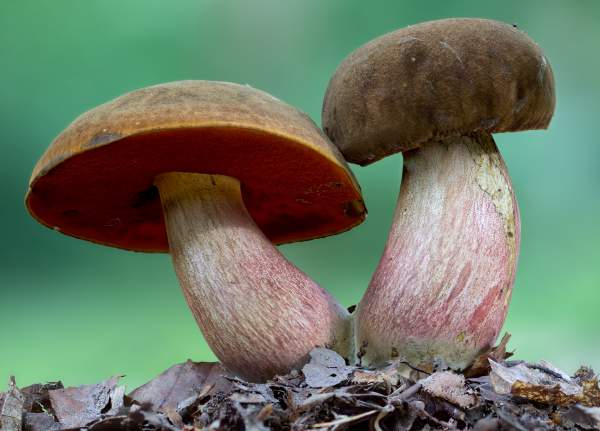
The Scarletina Bolete is a visually striking mushroom known for its vibrant red pores and stem, contrasting with a brownish cap. It is found in deciduous and coniferous woodlands and forms mycorrhizal relationships with trees. While some sources list it as edible, others advise caution due to potential gastrointestinal upset in some individuals. It's crucial to avoid confusion with toxic look-alikes.
How to Identify
- Cap
- Cap is initially convex, becoming more flattened with age. The color ranges from tan to brown, often with reddish or orange hues. The surface is dry and smooth, sometimes slightly velvety.
- Gills
- N/A (bolete with pores). Pores are small, round, and bright red, bruising blue when handled.
- Stem
- The stem is stout, club-shaped to cylindrical, and typically red or reddish-pink, often with a fine network of ridges (reticulation) near the top.
- Flesh
- The flesh is yellowish, often staining blue when cut or bruised, especially in the stem. This bluing reaction is a key identifying feature.
- Fruiting body
- Medium to large size, with a distinctive red pore surface and stem.
- Habitat
- Found in deciduous and coniferous forests, forming mycorrhizal associations with trees.
Key Facts
- Cap surfaces: Dry, smooth, sometimes velvety
- Growth Form: Solitary or scattered
- Spore Print: Olive-brown
- Body color: Red stem and pores, brownish cap
- Odor: Mild, not distinctive
- Flesh bruises: Blue
- Height: 5-12 cm
- Cap Diameter: 5-15 cm
- Nutrient gathering: Mycorrhizal
Safe
Mild ToxicityWhile some sources list Boletus luridiformis as edible when cooked, it can cause gastrointestinal upset if eaten raw or undercooked. It is essential to cook it thoroughly. Some individuals may still experience adverse reactions. Confusion with other toxic red-pored boletes is a significant risk.
Quick Check
- Odor: Mild
- Fruiting: Summer to autumn
- Substrate: Soil in woodlands
Where to Find
Europe and North America
Deciduous and coniferous woodlands
Finding Tips
Habitat
Look for it near oak, beech, and pine trees.
Season
Fruiting occurs from summer to autumn.
Similar Species
Boletus chrysenteron
Mushroom of the Boletus genus
Also known as: Red cracking bolete
Rubroboletus queletii
Mushroom of the Boletus genus
Also known as: Deceiving bolete
Scientific Classification
- Phylum
- Basidiomycota
- Class
- Agaricomycetes
- Order
- Boletales
- Family
- Boletaceae
- Genus
- Boletus
Storage Information
- Max Temperature: 2
- Freezing duration: 3 months
- Min Temperature: -18
- Refrigeration: 2-3 days
How to Clean
Gently brush off any dirt or debris. Avoid soaking in water, as boletes can become waterlogged. A dry cloth or soft brush works best.
Explore Scarletina Bolete
Identify mushrooms anywhere
Free on iOS, Android, and Web. Photo identification, full database, and your personal collection.