
Got a photo? Identify mushrooms instantly with the Mushby app
Open the appDescription
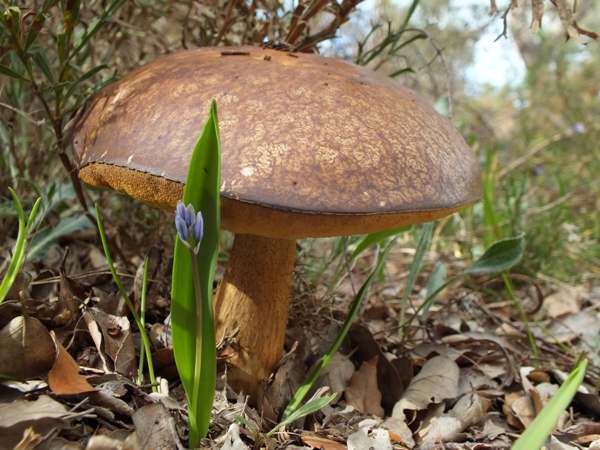
The Bronze Bolete (Boletus aereus) is a highly prized edible mushroom characterized by its dark brown to blackish-brown cap and robust stature. It is found primarily in broadleaf forests, forming symbiotic relationships with trees such as oak and beech.
How to Identify
- Cap
- The cap is dark brown to blackish-brown, often with a slightly wrinkled or bumpy texture. It is typically convex when young, flattening out with age. The surface is dry and not sticky.
- Gills
- N/A (boletes have pores instead of gills). The pore surface is initially whitish, turning yellowish to greenish-yellow with age. The pores are small and round.
- Stem
- The stem is stout and club-shaped to cylindrical, often with a slightly bulbous base. It is typically brown, similar in color to the cap or slightly lighter. The stem surface can be smooth or slightly reticulated (covered with a net-like pattern).
- Flesh
- The flesh is firm and white, sometimes with a brownish tinge under the cap cuticle. It usually does not change color when cut, or may turn slightly blue in some instances.
- Fruiting body
- Overall, the mushroom is large and robust, with a substantial cap and thick stem. The color is predominantly dark brown, and the pores are typically whitish when young, turning yellowish to greenish with age.
- Habitat
- Found in broadleaf forests, particularly associated with oak and beech trees. Prefers warm climates and well-drained soils.
Key Facts
- Cap surfaces: Dry, slightly wrinkled or bumpy
- Growth Form: Solitary or scattered
- Spore Print: Olive-brown
- Body color: Dark brown to blackish-brown
- Odor: Pleasant, mushroomy
- Flesh bruises: Usually does not change color, or may turn slightly blue
- Height: 10-20 cm
- Cap Diameter: 10-30 cm
- Nutrient gathering: Mycorrhizal
Safe
SafeBoletus aereus is not toxic and is considered an excellent edible mushroom. However, it is important to properly identify it to avoid confusion with other potentially toxic boletes.
Quick Check
- Odor: Pleasant and mushroomy
- Fruiting: Late summer to autumn
- Substrate: Soil under broadleaf trees, especially oak and beech
Where to Find
Europe
Found in broadleaf forests, particularly under oak and beech trees.
Mediterranean regions
Prefers warm climates and well-drained soils.
Finding Tips
Timing
Look for them during late summer and autumn after periods of rain.
Habitat
Check areas with mature oak and beech trees, especially where the canopy is open enough to allow sunlight to reach the forest floor.
Similar Species
Porcini
Mushroom belonging to the Boletus genus
Also known as: B. edulis
Pine Bolete
Mushroom belonging to the Boletus genus
Also known as: B. pinophilus
Scientific Classification
- Phylum
- Basidiomycota
- Class
- Agaricomycetes
- Order
- Boletales
- Family
- Boletaceae
- Genus
- Boletus
Storage Information
- Max Temperature: 20
- Freezing duration: 6-12 months
- Min Temperature: 2
- Refrigeration: 2-3 days
How to Clean
Gently brush off any dirt or debris from the cap and stem. Avoid soaking in water, as boletes can become waterlogged. A soft brush or a slightly damp cloth can be used to clean the surface.
Explore Bronze Bolete
Identify mushrooms anywhere
Free on iOS, Android, and Web. Photo identification, full database, and your personal collection.