
Got a photo? Identify mushrooms instantly with the Mushby app
Open the appDescription
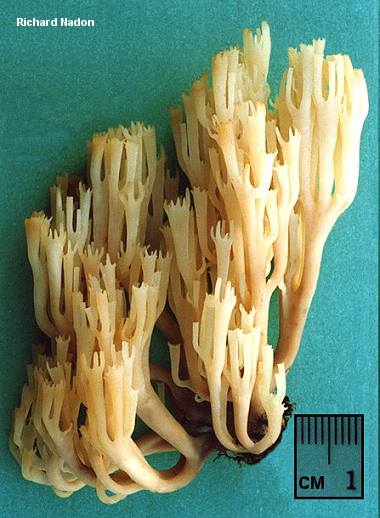
Artomyces pyxidatus, commonly known as the Crown-tipped Coral, is a distinctive saprobic fungus characterized by its intricate, coral-like fruiting bodies. It is easily recognized by the crown-like tips of its branches, which are formed by multiple small points. This species plays an important ecological role as a decomposer of dead wood, primarily hardwoods.
How to Identify
- Cap
- Not applicable, as this is a coral fungus and does not have a distinct cap.
- Gills
- Not applicable, as this is a coral fungus and does not have gills.
- Stem
- A short, stout, and often indistinct stem or base supports the branched structure. It is typically whitish and can be somewhat hairy or fuzzy at the very base where it attaches to the wood.
- Flesh
- The flesh is white, firm but somewhat brittle when fresh, becoming tougher with age. It does not change color when bruised.
- Fruiting body
- The fruiting body is highly branched, resembling a coral, growing up to 15 cm tall and 10 cm wide. It is typically white to cream-colored, sometimes with yellowish or brownish tints, especially with age or bruising. The most distinguishing feature is the 'crown-tipped' appearance of the branch apices, where each branch terminates in 3-5 small, pointed projections.
- Habitat
- Saprobic, growing on dead and decaying wood, primarily hardwoods (e.g., oak, maple, birch, beech), but occasionally found on conifers. It typically grows on fallen logs, stumps, or buried wood.
Key Facts
- Cap surfaces: Not applicable (coral fungus)
- Growth Form: Branched, coral-like, arising from a common base.
- Spore Print: White to cream.
- Body color: White to cream, sometimes yellowish or brownish with age.
- Odor: Mild, pleasant.
- Flesh bruises: Does not bruise or change color.
- Height: Up to 15 cm (6 inches)
- Cap Diameter: Not applicable (coral fungus)
- Nutrient gathering: Saprobic (decomposer of dead wood).
Safe
SafeArtomyces pyxidatus is generally considered edible and good, but like all wild mushrooms, individual sensitivities can vary. Some people may experience mild gastrointestinal upset. It is crucial to correctly identify this mushroom, as some other coral fungi can be mildly laxative or cause digestive issues. Always cook thoroughly before consumption.
Quick Check
- Odor: Mild, pleasant, sometimes described as slightly radish-like or earthy.
- Fruiting: Late spring to late autumn.
- Substrate: Dead hardwood logs and stumps.
Where to Find
North America
Widely distributed across temperate regions, particularly in eastern North America.
Europe
Common throughout Europe.
Asia
Also found in parts of Asia.
Finding Tips
Substrate Preference
Look for it on dead hardwood logs and stumps, especially in moist, shaded areas of deciduous or mixed forests.
Seasonality
Typically fruits from late spring through autumn, with peak abundance in summer and early fall after periods of rain.
Distinguishing Features
Always check for the characteristic crown-like tips on the branches to differentiate it from other coral fungi.
Similar Species
White Coral Fungus
fungus
Also known as: Clavulina cristata
Crested Coral
fungus
Also known as: Clavulina coralloides
Yellow Coral Fungus
fungus
Also known as: Ramaria flava
Scientific Classification
- Phylum
- Basidiomycota
- Class
- Agaricomycetes
- Order
- Russulales
- Family
- Auriscalpiaceae
- Genus
- Artomyces
Storage Information
- Max Temperature: 4°C
- Freezing duration: 6 months
- Min Temperature: 0°C
- Refrigeration: 5 days
How to Clean
Gently brush off any debris (leaves, soil) with a soft brush. If necessary, a quick rinse under cold water can be done, but avoid soaking as they can become waterlogged. Pat dry immediately.
Explore Crown-tipped Coral
Identify mushrooms anywhere
Free on iOS, Android, and Web. Photo identification, full database, and your personal collection.