
Got a photo? Identify mushrooms instantly with the Mushby app
Open the appDescription
Armillaria tabescens, commonly known as the Ringless Honey Mushroom or Dwarf Honey Mushroom, is a species of fungus in the family Physalacriaceae. It is typically found growing on decaying wood and is widely distributed across North America and Europe. It is edible, but caution is advised due to potential confusion with toxic look-alikes.
How to Identify
- Cap
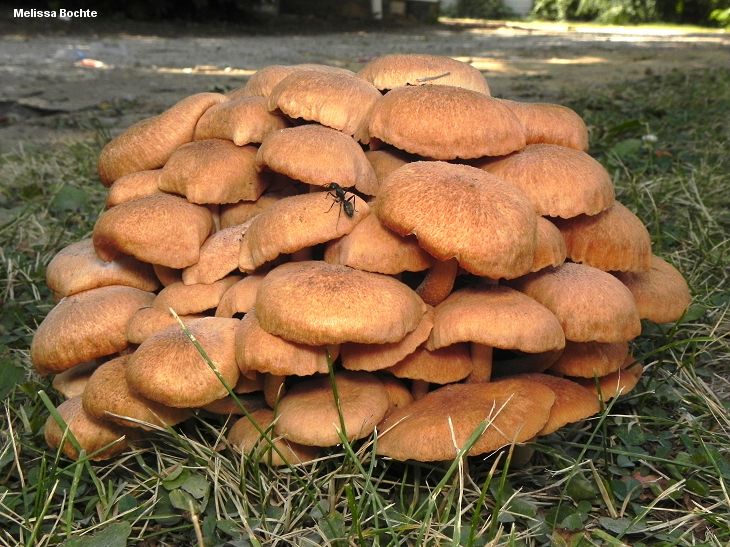
- The cap is convex to flattened, often with a central bump (umbo). It is typically dry and smooth, with a color ranging from tan to brown. The cap surface may have small scales or fibrils.
- Gills
- The gills are attached to the stem (adnate to decurrent), closely spaced, and white to cream-colored. They may develop brownish spots with age.
- Stem
- The stem is slender, cylindrical, and tapers slightly towards the base. It is typically dry and smooth, with a color similar to the cap or slightly lighter. A distinctive feature is the absence of a ring (annulus).
- Flesh
- The flesh is white to cream-colored and does not change color when bruised.
- Fruiting body
- The fruiting body of Armillaria tabescens is a mushroom with a cap and stem. It typically grows in clusters.
- Habitat
- Armillaria tabescens is typically found growing on decaying wood, such as logs, stumps, and roots of hardwood trees. It often grows in clusters and can be found in forests and woodlands.
Key Facts
- Cap surfaces: Dry, smooth, may have small scales or fibrils
- Growth Form: Clustered
- Spore Print: White
- Body color: Tan to brown
- Odor: Mild and mushroomy
- Flesh bruises: Does not change color
- Height: 3-10 cm
- Cap Diameter: 2-8 cm
- Nutrient gathering: Saprophytic
Safe
Mild ToxicityArmillaria tabescens is generally considered edible, but caution is advised due to potential confusion with toxic look-alikes. Some individuals may experience gastrointestinal upset after consuming them, so it is recommended to cook them thoroughly and consume them in moderation.
Quick Check
- Odor: Mild and mushroomy
- Fruiting: Grows in clusters on decaying wood
- Substrate: Decaying hardwood
Where to Find
North America
Widely distributed across North America, particularly in eastern regions.
Europe
Found in various European countries, often in deciduous forests.
Finding Tips
Look for Decaying Wood
Search for Armillaria tabescens around decaying logs, stumps, and roots of hardwood trees.
Check for Clusters
These mushrooms often grow in clusters, so if you find one, look for others nearby.
Similar Species
Galerina marginata
Mushroom
Also known as: Funeral Bell
Scientific Classification
- Phylum
- Basidiomycota
- Class
- Agaricomycetes
- Order
- Agaricales
- Family
- Physalacriaceae
- Genus
- Armillaria
Storage Information
- Max Temperature: 4°C (39°F)
- Freezing duration: 3-6 months
- Min Temperature: 2°C (36°F)
- Refrigeration: 2-3 days
How to Clean
To clean Armillaria tabescens, gently brush off any dirt or debris from the cap and stem. Avoid soaking them in water, as they can become waterlogged. A soft brush or damp cloth can be used to remove stubborn dirt.
Explore Dwarf Honey Mushroom
Identify mushrooms anywhere
Free on iOS, Android, and Web. Photo identification, full database, and your personal collection.