
Got a photo? Identify mushrooms instantly with the Mushby app
Open the appDescription
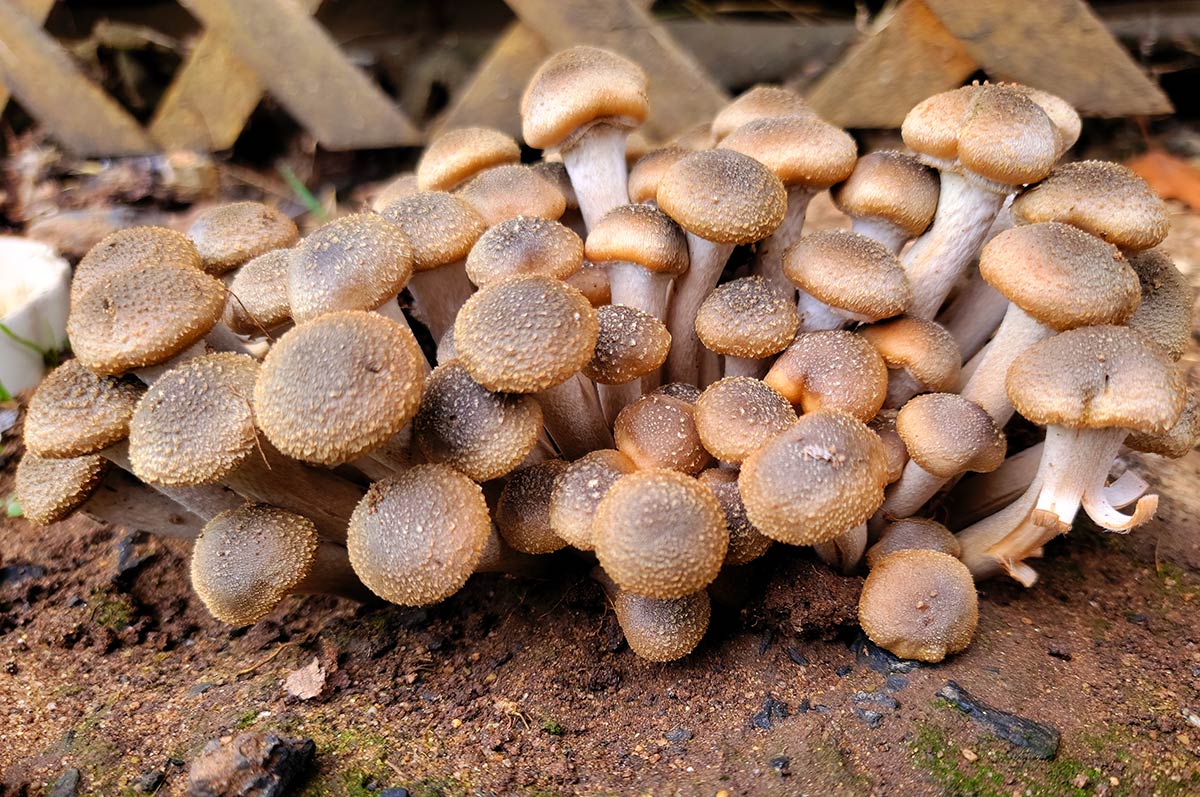
Armillaria ostoyae, commonly known as the Honey Mushroom or Dark Honey Fungus, is a widespread and ecologically significant basidiomycete fungus. It is known for its parasitic nature, causing root rot in a wide range of coniferous and deciduous trees, and its saprobic role in decomposing dead wood. It is also famous for forming some of the largest known living organisms on Earth, with vast underground mycelial networks. The fruiting bodies typically grow in dense clusters at the base of trees or on stumps and fallen logs.
How to Identify
- Cap
- Caps are typically 3-15 cm (1.2-6 inches) in diameter, convex to broadly convex or nearly flat with age, often with a central umbo. The color varies from yellowish-brown to reddish-brown, often darker towards the center. The most distinctive feature is the presence of numerous, small, dark brown to blackish, erect scales (fibrils) on the cap surface, especially when young, which become sparser or disappear with age, particularly towards the margin. The margin is often incurved when young and may be striate (lined) in older specimens.
- Gills
- Gills are adnate to slightly decurrent, close to crowded, and initially white to cream, becoming yellowish or pinkish-buff with age, often developing rusty brown spots. They are covered by a partial veil when young.
- Stem
- The stem is 5-20 cm (2-8 inches) long and 1-3 cm (0.4-1.2 inches) thick, central or eccentric, tapering slightly towards the base or sometimes swollen. It is fibrous and tough, especially towards the base. The color is similar to the cap, often paler above the ring and darker below. A prominent, persistent, cottony-membranous ring (annulus) is present on the upper part of the stem, often with a yellowish, cottony margin and a dark, often spore-stained underside. Below the ring, the stem surface is typically covered with dark, woolly scales or fibrils, which are a key distinguishing feature from other Armillaria species.
- Flesh
- The flesh is white, firm, and thick, especially in the cap. It does not change color when cut or bruised. It has a mild, sometimes slightly bitter taste and a mushroomy odor.
- Fruiting body
- The fruiting bodies of Armillaria ostoyae typically grow in dense clusters, often numbering in the dozens or hundreds, emerging from the base of trees, stumps, or buried wood. They are robust and fleshy.
- Habitat
- Armillaria ostoyae is a parasitic and saprobic fungus, growing on living trees (especially conifers like fir, spruce, and pine, but also hardwoods like oak and maple), stumps, and buried wood. It causes white rot. It is often found in large clusters at the base of infected trees or on dead wood.
Key Facts
- Cap surfaces: Dry, scaly (especially when young)
- Growth Form: Clustered, gregarious
- Spore Print: White to cream
- Body color: Yellowish-brown to reddish-brown
- Odor: Mild, mushroomy
- Flesh bruises: No
- Height: 5-20 cm (2-8 inches)
- Cap Diameter: 3-15 cm (1.2-6 inches)
- Nutrient gathering: Parasitic and Saprobic
Safe
Mild ToxicityArmillaria ostoyae is considered edible when properly cooked, but it must be thoroughly cooked. Raw or undercooked specimens can cause gastrointestinal upset in some individuals. Some people may experience mild gastrointestinal distress even with cooked specimens, especially with larger quantities. It is crucial to distinguish it from toxic look-alikes such as Omphalotus illudens (Jack O'Lantern mushroom) and Hypholoma fasciculare (Sulphur Tuft).
Quick Check
- Odor: Mild, mushroomy
- Fruiting: Late summer to late autumn
- Substrate: Base of living trees (conifers and hardwoods), stumps, buried wood
Where to Find
North America
Widespread across coniferous and mixed forests, particularly in the Pacific Northwest, Rocky Mountains, and northeastern regions.
Europe
Common in various forest types, especially in northern and central Europe.
Asia
Found in temperate forest regions, including parts of Russia and East Asia.
Finding Tips
Look for Clusters
Armillaria ostoyae almost always grows in dense clusters, often at the base of trees or on stumps. Solitary specimens are rare.
Check for a Prominent Ring
A key feature is the persistent, cottony-membranous ring on the stem, which often has a dark, spore-stained underside.
Examine Stem Scales
Below the ring, the stem is typically covered with dark, woolly scales or fibrils, which helps differentiate it from other honey mushrooms.
Observe Cap Scales
Young caps have distinctive dark, erect scales, especially in the center. These may fade with age but are usually present to some degree.
Seasonality
Typically fruits in late summer and autumn, often after significant rainfall.
Host Trees
While it can grow on various trees, it is particularly common on conifers. Look for signs of tree stress or decline, as it is a pathogen.
Similar Species
Ringless Honey Mushroom
Desarmillaria tabescens
Also known as: Ringless Armillaria
Jack O'Lantern Mushroom
Omphalotus illudens
Also known as: Eastern Jack O'Lantern
Sulphur Tuft
Hypholoma fasciculare
Also known as: Clustered Woodlover
Sheathed Woodtuft
Kuehneromyces mutabilis
Also known as: Changeable Pholiota
Scientific Classification
- Phylum
- Basidiomycota
- Class
- Agaricomycetes
- Order
- Agaricales
- Family
- Physalacriaceae
- Genus
- Armillaria
Storage Information
- Max Temperature: 4
- Freezing duration: 12 months
- Min Temperature: 0
- Refrigeration: 5-7 days
How to Clean
Clean Honey Mushrooms by gently brushing off any dirt or debris with a soft brush or damp cloth. Avoid washing them under running water, as they can become waterlogged. Trim off any tough or damaged parts of the stem. The stems can be quite fibrous and are often discarded or used for stock, while the caps are preferred for eating.
Explore Honey Mushroom
Identify mushrooms anywhere
Free on iOS, Android, and Web. Photo identification, full database, and your personal collection.