
Got a photo? Identify mushrooms instantly with the Mushby app
Open the appDescription
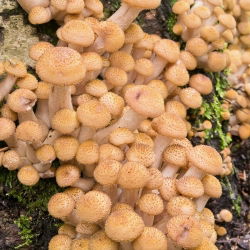
Armillaria mellea, commonly known as honey fungus, is a species of parasitic fungi that belongs to the family Physalacriaceae. It is a widespread and destructive pathogen of trees and woody plants. The fungus forms distinctive honey-colored mushrooms, typically in clusters at the base of infected trees or on decaying wood. While some Armillaria species are edible, they require careful identification and cooking to avoid potential toxicity.
How to Identify
- Cap
- The cap is typically 3-15 cm in diameter, convex to flattened, and has a honey-yellow to brownish color. The surface may be slightly sticky when moist and often has small scales or fibrils.
- Gills
- The gills are attached to the stem (adnate to slightly decurrent), closely spaced, and white to cream-colored. They may develop brownish spots with age.
- Stem
- The stem is typically 5-20 cm long and 1-3 cm thick, often tapering towards the base. It is yellowish-brown to brown in color and may have a ring (annulus) near the top. The stem surface can be fibrous or scaly.
- Flesh
- The flesh of the cap is white to pale yellow and does not change color when bruised.
- Fruiting body
- The fruiting bodies of Armillaria mellea are mushrooms that typically grow in clusters. They have a cap, gills, and a stem.
- Habitat
- Armillaria mellea is commonly found at the base of trees, on decaying wood, or in the soil near infected trees. It can grow on a wide variety of deciduous and coniferous trees.
Key Facts
- Cap surfaces: Slightly sticky when moist, often with small scales or fibrils
- Growth Form: Clustered
- Spore Print: White
- Body color: Honey-yellow to brownish
- Odor: Faintly mushroomy or slightly acidic
- Flesh bruises: Does not change color
- Height: 5-20 cm
- Cap Diameter: 3-15 cm
- Nutrient gathering: Saprophytic/Parasitic
Toxic
Mild ToxicitySome species of Armillaria, including Armillaria mellea, can cause gastrointestinal upset in some individuals. Cooking the mushrooms thoroughly can help reduce the risk of toxicity. It is essential to properly identify the species before consumption, as some look-alikes can be poisonous.
Quick Check
- Odor: Faintly mushroomy or slightly acidic
- Fruiting: Typically in clusters at the base of trees or on decaying wood
- Substrate: Decaying wood or soil near infected trees
Where to Find
North America
Common in forests throughout North America, especially in areas with both deciduous and coniferous trees.
Europe
Widespread across Europe, found in various forest types and wooded areas.
Asia
Found in many parts of Asia, including Japan, China, and Korea, often associated with forests and plantations.
Finding Tips
Look for Clusters
Honey fungus typically grows in clusters at the base of trees or on decaying wood. Check around the base of trees, especially those that appear stressed or are already dead.
Check Decaying Wood
Inspect decaying logs, stumps, and woody debris for clusters of honey-colored mushrooms.
Autumn Season
Honey fungus is most commonly found in the autumn months. Search after periods of rain when mushrooms are more likely to fruit.
Similar Species
Jack O'Lantern Mushroom
toxic fungi
Also known as: Omphalotus olearius
Galerina marginata
deadly poisonous mushroom
Also known as: Funeral Bell
Scientific Classification
- Phylum
- Basidiomycota
- Class
- Agaricomycetes
- Order
- Agaricales
- Family
- Physalacriaceae
- Genus
- Armillaria
Explore Honey Fungus
Identify mushrooms anywhere
Free on iOS, Android, and Web. Photo identification, full database, and your personal collection.