
Got a photo? Identify mushrooms instantly with the Mushby app
Open the appDescription
Amanita strobiliformis is a large, striking mushroom characterized by its robust stature and prominent, pyramidal warts on the cap, which give it a 'pine cone' appearance. It is a mycorrhizal fungus, forming symbiotic relationships with various deciduous trees. While often considered edible by some, its close resemblance to toxic Amanita species necessitates extreme caution and it is generally not recommended for consumption.
How to Identify
- Cap
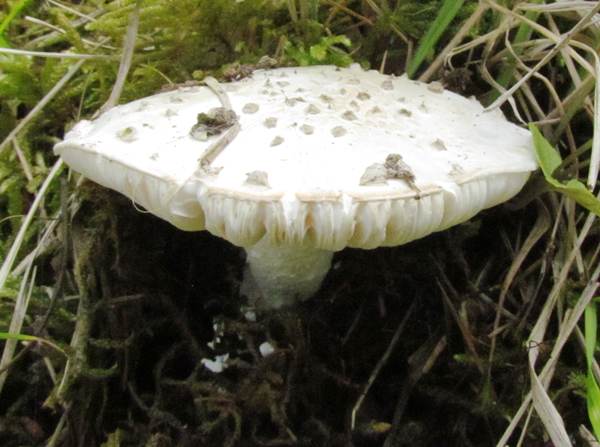
- 5-20 cm in diameter, white to off-white, covered with large, prominent, pyramidal, often brownish or grayish warts that are remnants of the universal veil. The margin is often appendiculate with veil remnants.
- Gills
- Free or narrowly attached, crowded, white to cream, sometimes with a slightly serrated edge.
- Stem
- 8-20 cm long, 1.5-4 cm thick, white, solid, tapering slightly upwards from a bulbous base. The stem is often shaggy or scaly below the ring. It has a large, pendulous, membranous, white ring that is often striate on the upper surface. The volva is typically a series of concentric rings or a collar-like structure at the base, often breaking up and becoming less distinct with age.
- Flesh
- Thick, white, firm, and does not change color when cut or bruised.
- Fruiting body
- Large and robust, initially egg-shaped, expanding to convex and then flat.
- Habitat
- Solitary or scattered in deciduous and mixed woodlands, particularly under oak, beech, and hornbeam trees. It is a mycorrhizal species.
Key Facts
- Cap surfaces: Dry, covered with large, pyramidal, often brownish or grayish warts.
- Growth Form: Solitary or scattered.
- Spore Print: White.
- Body color: White to off-white.
- Odor: Mild, sometimes radish-like.
- Flesh bruises: No color change.
- Height: 8-20 cm
- Cap Diameter: 5-20 cm
- Nutrient gathering: Mycorrhizal.
Toxic
DeadlyAmanita strobiliformis is generally considered inedible or of unknown edibility. While some sources list it as edible after cooking, it is extremely difficult to distinguish from highly toxic Amanita species, particularly those in the 'Lepidella' section that contain lethal amatoxins or other dangerous compounds. Therefore, it is strongly advised against consumption. Ingestion could lead to severe gastrointestinal upset, kidney failure, or liver damage, potentially fatal.
Quick Check
- Odor: Mild, sometimes described as radish-like or earthy.
- Fruiting: Late summer to autumn.
- Substrate: Terrestrial, mycorrhizal with deciduous trees.
Where to Find
Europe
Widespread across temperate regions of Europe.
North America
Found in eastern North America, though some North American collections previously identified as A. strobiliformis may represent distinct species within the 'Lepidella' section.
Finding Tips
Habitat Preference
Look in deciduous and mixed forests, especially near oak, beech, and hornbeam trees. It prefers well-drained soils.
Seasonality
Typically fruits from late summer to autumn (August to October).
Distinctive Features
Focus on the large, pyramidal warts on the cap, the robust stem with a prominent ring, and the bulbous base with volval remnants. Always check for the presence of a volva, even if it's fragmented.
Similar Species
Destroying Angel
Amanita
Also known as: Death Angel
Death Cap
Amanita
Also known as: Fools Mushroom
Blusher
Amanita
Also known as: Amanita rubescens
False Death Cap
Amanita
Also known as: Citron Amanita
Scientific Classification
- Phylum
- Basidiomycota
- Class
- Agaricomycetes
- Order
- Agaricales
- Family
- Amanitaceae
- Genus
- Amanita
Explore Pine Cone Lepidella
Identify mushrooms anywhere
Free on iOS, Android, and Web. Photo identification, full database, and your personal collection.