
Got a photo? Identify mushrooms instantly with the Mushby app
Open the appDescription
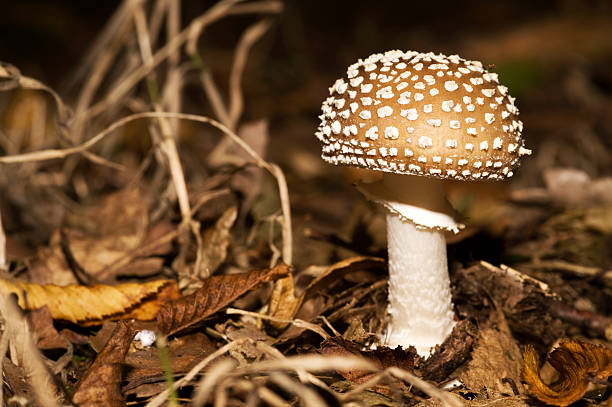
Amanita pantherina, commonly known as the Panther Cap, is a poisonous mushroom belonging to the genus Amanita. It is characterized by its distinctive brown cap covered with white warts and is found in both deciduous and coniferous forests.
How to Identify
- Cap
- The cap is typically 5-15 cm in diameter, brown to tan in color, and covered with numerous white, cottony warts. The cap is initially convex, becoming flattened with age. The margin is striate (grooved).
- Gills
- The gills are free, crowded, and white.
- Stem
- The stem is 5-15 cm long and 1-2 cm thick, white, and has a bulbous base. It features a ring (annulus) that is often fragile and may disappear with age. The base of the stem has a distinct, collar-like volva.
- Flesh
- The flesh is white and does not change color when bruised.
- Fruiting body
- The fruiting body of Amanita pantherina is a mushroom with a cap and a stem.
- Habitat
- Amanita pantherina is found in both deciduous and coniferous forests, often near oak and pine trees. It typically fruits in late summer and autumn.
Key Facts
- Cap surfaces: Brown with white warts
- Growth Form: Solitary or scattered
- Spore Print: White
- Body color: Brown and white
- Odor: Unpleasant
- Flesh bruises: Does not bruise
- Height: 5-15 cm
- Cap Diameter: 5-15 cm
- Nutrient gathering: Mycorrhizal
Toxic
DeadlyAmanita pantherina is highly toxic and contains ibotenic acid and muscimol, which can cause severe neurological symptoms.
Quick Check
- Odor: Unpleasant, sometimes described as radish-like
- Fruiting: Late summer to autumn
- Substrate: Soil, under deciduous and coniferous trees
Where to Find
Europe
Common throughout Europe, including the UK, France, and Germany.
North America
Found in some regions of North America, particularly the Pacific Northwest and the East Coast.
Asia
Occurs in parts of Asia, including Japan and Korea.
Finding Tips
Look for Specific Trees
Search near oak and pine trees, as Amanita pantherina often forms mycorrhizal associations with these trees.
Check in Late Summer and Autumn
This mushroom typically fruits in late summer and autumn, so focus your search during these seasons.
Examine the Forest Floor
Look for mushrooms with brown caps and white warts on the forest floor, especially in areas with leaf litter.
Similar Species
Amanita rubescens
mushroom
Also known as: Blusher
Amanita excelsa
mushroom
Also known as: European False Blusher
Scientific Classification
- Phylum
- Basidiomycota
- Class
- Agaricomycetes
- Order
- Agaricales
- Family
- Amanitaceae
- Genus
- Amanita
Explore Panther Cap
Identify mushrooms anywhere
Free on iOS, Android, and Web. Photo identification, full database, and your personal collection.