
Got a photo? Identify mushrooms instantly with the Mushby app
Open the appDescription
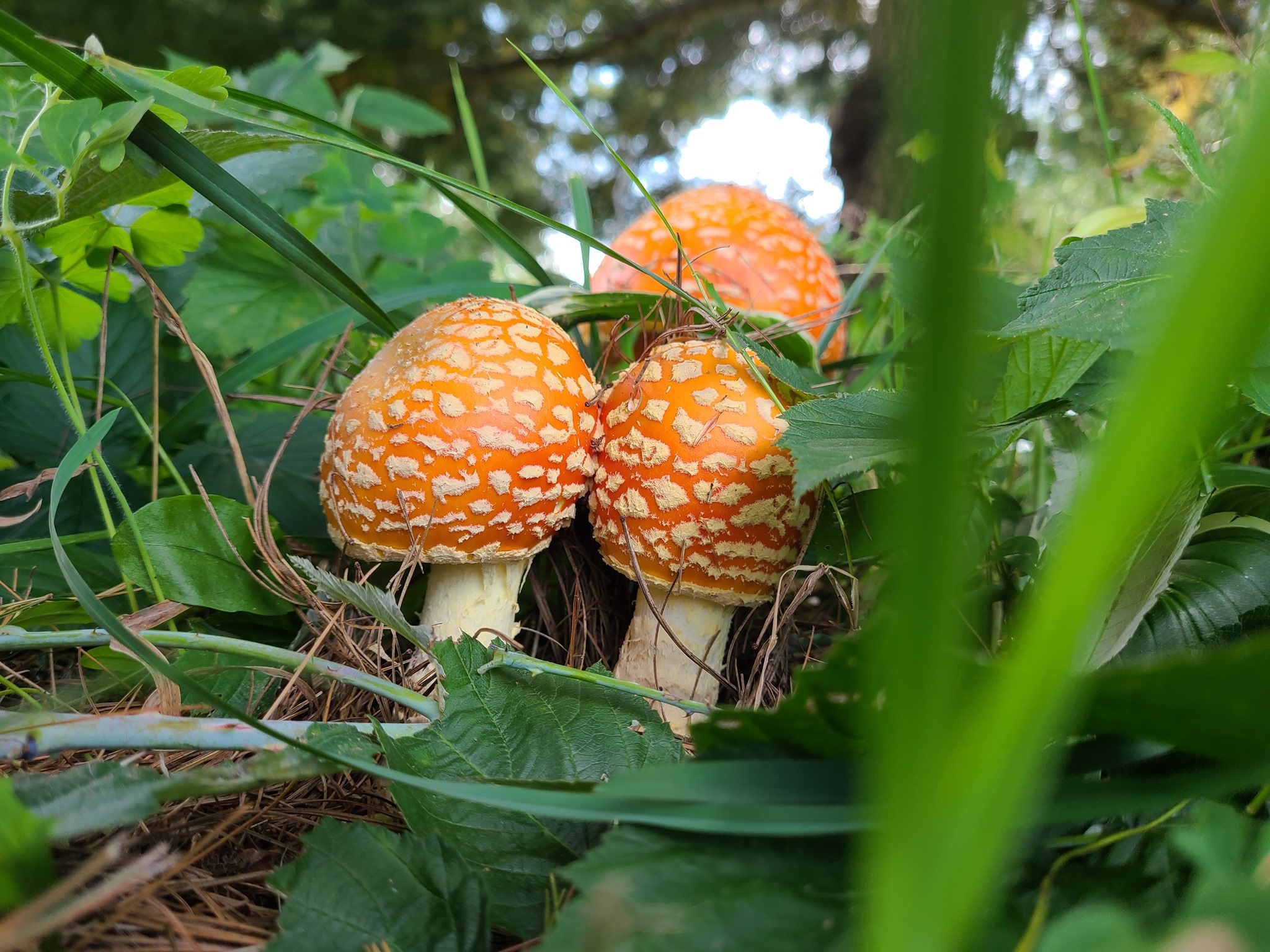
Amanita muscaria var. guessowii is a distinct variety of the widely recognized Fly Agaric, primarily found in northeastern North America. It is characterized by its vibrant yellow to orange cap, often adorned with whitish to yellowish warts (volva remnants). While visually striking, it contains muscimol and ibotenic acid, making it hallucinogenic and toxic if consumed without proper detoxification.
How to Identify
- Cap
- 3-20 cm (1.2-8 inches) in diameter, convex to broadly convex or flat at maturity. Color ranges from golden yellow to orange-yellow, sometimes fading to pale yellow in age or with exposure. The surface is often sticky when moist, becoming dry. Typically covered with whitish to yellowish patches or warts, which are remnants of the universal veil and are easily removable.
- Gills
- Free to adnexed, crowded, white to cream-colored. Often with a serrated edge in mature specimens.
- Stem
- 5-20 cm (2-8 inches) long and 1-3 cm (0.4-1.2 inches) thick, tapering slightly upwards or cylindrical, flaring at the base to form a bulbous volva. White to yellowish, often shaggy or scaly above the ring. A persistent, membranous ring (annulus) is present, initially white but can become stained yellowish from spores falling onto it. The base of the stem has concentric rings or a collar of universal veil remnants, forming a distinct volva.
- Flesh
- White, firm, and relatively thick. Does not change color when cut or bruised.
- Fruiting body
- Typical agaric (gilled mushroom) morphology with a cap, gills, stem, ring, and volva remnants.
- Habitat
- Mycorrhizal with conifers and hardwoods, particularly birch, pine, spruce, and fir. Grows solitarily or scattered on the ground in woodlands.
Key Facts
- Cap surfaces: Sticky when moist, dry, covered with whitish to yellowish warts/patches
- Growth Form: Solitary or scattered
- Spore Print: White
- Body color: Cap: Golden yellow to orange-yellow; Gills: White to cream; Stem: White to yellowish
- Odor: Indistinct
- Flesh bruises: No bruising reaction
- Height: 5-20 cm (2-8 inches)
- Cap Diameter: 3-20 cm (1.2-8 inches)
- Nutrient gathering: Mycorrhizal
Toxic
Severe ToxicityAmanita muscaria var. guessowii is a psychoactive and toxic mushroom. It contains ibotenic acid and muscimol, which act as neurotoxins and hallucinogens. Symptoms of consumption can include nausea, vomiting, abdominal pain, diarrhea, confusion, disorientation, muscle spasms, hallucinations, altered perception of reality, drowsiness, and in severe cases, coma or seizures. Fatalities are rare but possible, especially with large doses or in individuals with underlying health conditions. DO NOT consume this mushroom without extreme caution and expert knowledge of detoxification methods, which are complex and not suitable for casual foragers.
Quick Check
- Odor: Indistinct or slightly mushroomy
- Fruiting: Late summer to late autumn
- Substrate: Ground, mycorrhizal with conifers and hardwoods
Where to Find
Northeastern North America
Widely distributed throughout the forests of New England, the Great Lakes region, and eastern Canada.
Pacific Northwest
Less common, but has been reported in certain areas, likely introduced or co-occurring with different tree associations.
Finding Tips
Tree Association
Look for it growing near birch, pine, spruce, or fir trees, as it forms mycorrhizal relationships with these species.
Seasonality
Best found from late summer through late autumn, typically after periods of rainfall.
Similar Species
European Fly Agaric
Amanita muscaria var. muscaria
Also known as: Red Fly Agaric
Amanita persicina
Amanita persicina
Also known as: Peach-colored Fly Agaric
Yellow Patches
Amanita flavoconia
Also known as: Yellow Warty Amanita
Gemmed Amanita
Amanita gemmata
Also known as: Jeweled Amanita
Scientific Classification
- Phylum
- Basidiomycota
- Class
- Agaricomycetes
- Order
- Agaricales
- Family
- Amanitaceae
- Genus
- Amanita
Explore American Fly Agaric
Identify mushrooms anywhere
Free on iOS, Android, and Web. Photo identification, full database, and your personal collection.