
Got a photo? Identify mushrooms instantly with the Mushby app
Open the appDescription
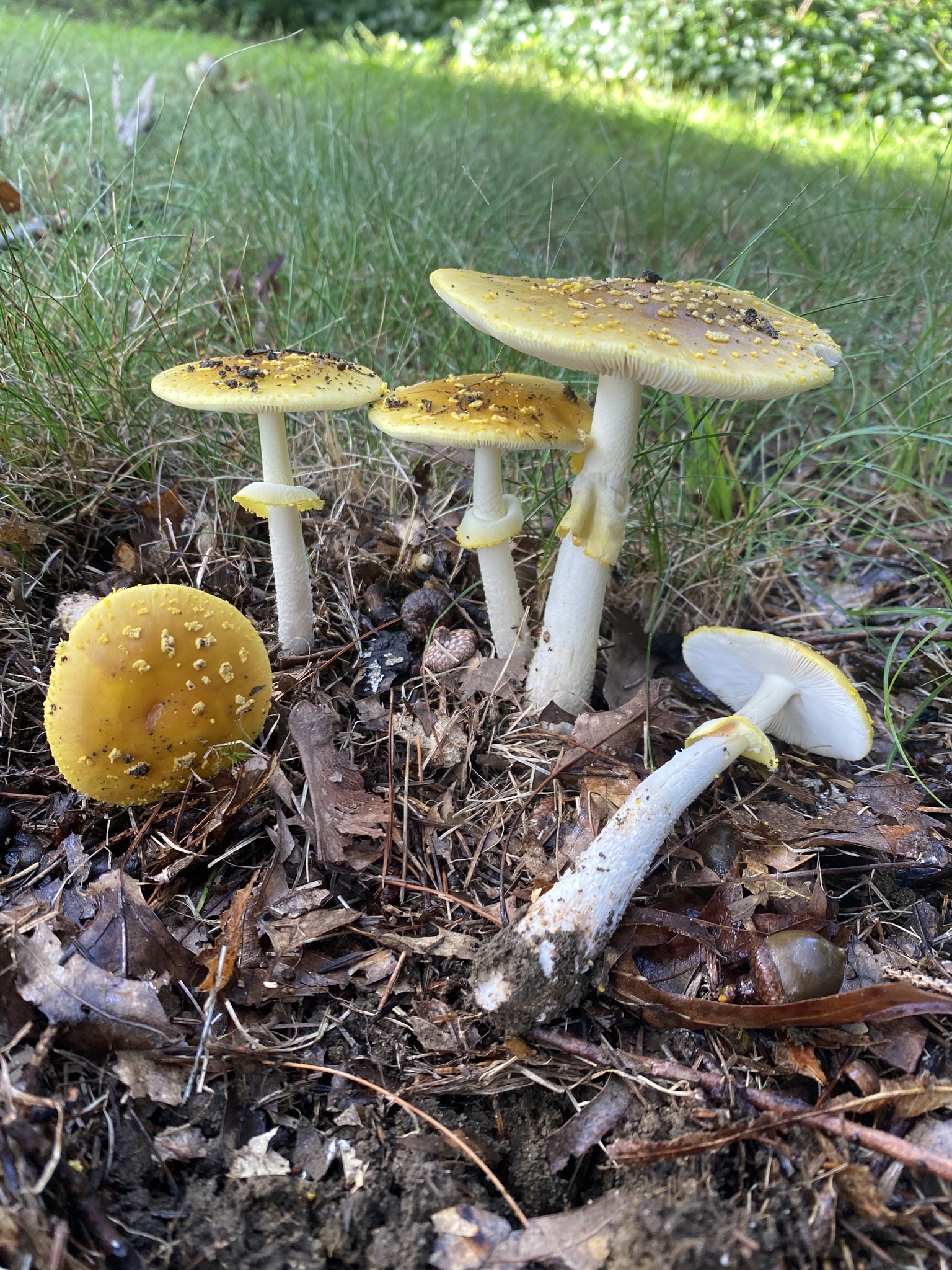
Amanita flavorubens, commonly known as the Yellow Blusher or American Blusher, is a mycorrhizal fungus belonging to the genus Amanita. It is characterized by its yellowish to brownish-yellow cap, often adorned with yellowish to reddish-brown warts, and its distinctive reddish staining (blushing) on injured parts, particularly the stem and gills. It is a member of the section Validae, which includes species with a volva that is typically friable or breaking up into rings or patches at the base of the stipe, and a prominent ring.
How to Identify
- Cap
- The cap of Amanita flavorubens ranges from 5 to 15 cm (2-6 inches) in diameter. It is initially convex, expanding to plano-convex or nearly flat with age. The color varies from yellowish-brown to golden-yellow, often with reddish-brown tints, especially towards the center. The surface is typically covered with numerous yellowish to reddish-brown, powdery to granular warts, which are remnants of the universal veil. The margin is usually non-striate or only faintly striate in older specimens.
- Gills
- The gills are free to adnexed, close to crowded, and white to cream-colored. They are soft and often stain reddish-brown when bruised or handled.
- Stem
- The stem (stipe) is 8 to 20 cm (3-8 inches) long and 1 to 2.5 cm (0.4-1 inch) thick, tapering slightly upwards or cylindrical. It is white to yellowish, often bruising reddish-brown, especially towards the base. A prominent, skirt-like ring (annulus) is present, typically yellowish and often with a striate upper surface. The base of the stem is bulbous, often with concentric rings or patches of yellowish to reddish-brown universal veil remnants, forming a friable volva.
- Flesh
- The flesh is white, firm, and thick. It stains reddish-brown when cut or bruised, particularly in the stem and gill areas. This 'blushing' reaction is a key diagnostic feature.
- Fruiting body
- The fruiting body is a typical agaric (gilled mushroom) with a cap, stem, and gills. It exhibits a characteristic 'blushing' reaction, turning reddish when bruised or cut.
- Habitat
- Amanita flavorubens is a mycorrhizal fungus, forming symbiotic relationships with the roots of various trees. It is commonly found growing solitarily or scattered on the ground in mixed deciduous and coniferous forests, particularly under oaks (Quercus), pines (Pinus), and hemlocks (Tsuga).
Key Facts
- Cap surfaces: Dry, covered with yellowish to reddish-brown warts
- Growth Form: Solitary to scattered
- Spore Print: White
- Body color: Yellowish-brown to golden-yellow cap, white to yellowish stem
- Odor: Mild
- Flesh bruises: Reddish-brown
- Height: 8-20 cm (3-8 inches)
- Cap Diameter: 5-15 cm (2-6 inches)
- Nutrient gathering: Mycorrhizal
Toxic
Moderate ToxicityAmanita flavorubens is considered inedible and potentially toxic. While not as deadly as some other Amanita species, it is known to cause gastrointestinal upset (nausea, vomiting, diarrhea) in some individuals. Due to the risk of misidentification with highly poisonous Amanitas, it is strongly advised against consumption.
Quick Check
- Odor: Mild, sometimes described as indistinct or slightly earthy.
- Fruiting: Summer to Fall
- Substrate: Terrestrial, mycorrhizal with various trees (oaks, pines, hemlocks)
Where to Find
Eastern North America
Predominantly found in eastern North America, from southeastern Canada south to Florida and west to the Great Plains.
Mixed Deciduous and Coniferous Forests
Commonly encountered in forests containing oak, pine, and hemlock trees, reflecting its mycorrhizal associations.
Finding Tips
Seasonal Availability
Typically fruits from summer through fall, with peak occurrences in late summer and early autumn.
Look for Blushing
Always check for the characteristic reddish-brown staining on the stem, gills, or cap flesh when bruised or cut. This is a crucial identification feature.
Examine the Volva
Carefully excavate the base of the stem to observe the volva remnants, which are usually friable and form concentric rings or patches, not a distinct sac.
Habitat Specificity
Focus searches in woodlands with known mycorrhizal hosts like oaks, pines, and hemlocks.
Similar Species
Blusher
Amanita
Also known as: Amanita rubescens
Fly Agaric
Amanita
Also known as: Amanita muscaria
Panther Cap
Amanita
Also known as: Amanita pantherina
Scientific Classification
- Phylum
- Basidiomycota
- Class
- Agaricomycetes
- Order
- Agaricales
- Family
- Amanitaceae
- Genus
- Amanita
Explore Yellow Blusher
Identify mushrooms anywhere
Free on iOS, Android, and Web. Photo identification, full database, and your personal collection.