
Got a photo? Identify mushrooms instantly with the Mushby app
Open the appDescription
Amanita bisporigera is a deadly poisonous basidiomycete fungus in the genus Amanita. It is a member of the group of mushrooms known as 'destroying angels' due to their lethal toxicity. This species is predominantly found in eastern North America and is responsible for a significant number of fatal mushroom poisonings.
How to Identify
- Cap
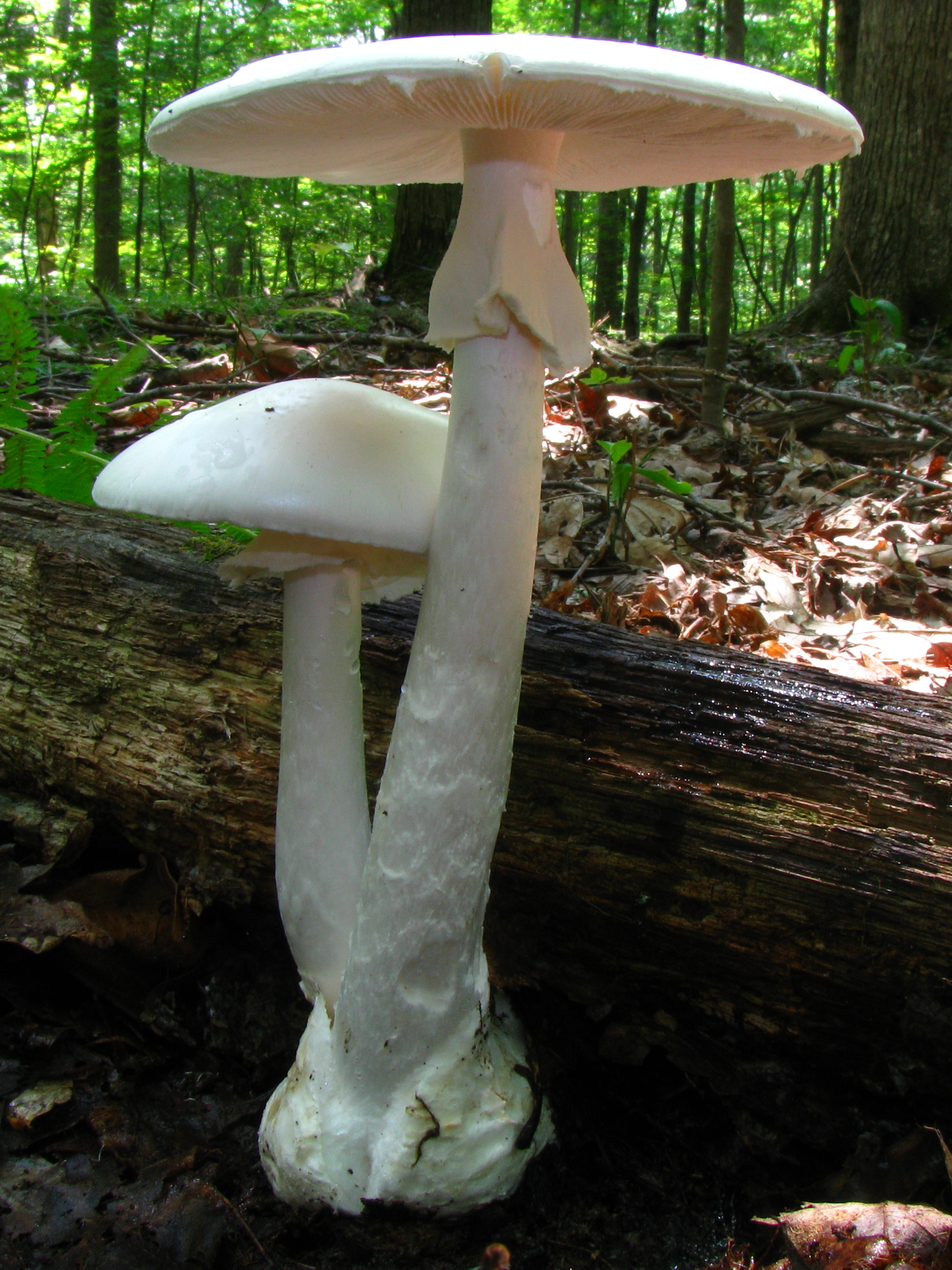
- The cap is 3-10 cm (1.2-3.9 in) in diameter, ovate to conical when young, becoming convex to almost flat with age. It is typically white, smooth, and dry, sometimes slightly sticky when moist. The margin is usually even and non-striate.
- Gills
- The gills are free from the stem, close to crowded, and white. They remain white with age.
- Stem
- The stem is 6-18 cm (2.4-7.1 in) long and 0.5-2 cm (0.2-0.8 in) thick, solid, becoming hollow with age. It is white, smooth or slightly fibrous, and tapers upwards from an enlarged base. A fragile, skirt-like annulus (ring) is present, often persistent. The most crucial feature is the large, sac-like, white volva (cup) at the base of the stem, which is often partially or entirely underground. Always dig carefully to excavate the entire base.
- Flesh
- The flesh is white, firm, and does not change color when cut or bruised.
- Fruiting body
- The fruiting body is typically all white, sometimes with a pale yellow or pinkish tint in the center of the cap. It often emerges from an egg-like structure (universan veil).
- Habitat
- Amanita bisporigera is a mycorrhizal fungus, forming symbiotic relationships with the roots of hardwoods, particularly oak (Quercus), hickory (Carya), and birch (Betula). It grows solitarily or scattered in deciduous and mixed forests.
Key Facts
- Cap surfaces: Smooth, dry, sometimes slightly sticky when moist.
- Growth Form: Solitary or scattered.
- Spore Print: White.
- Body color: Pure white, sometimes with a pale yellow or pinkish tint on the cap center.
- Odor: Indistinct to slightly sweet, not diagnostic.
- Flesh bruises: Does not bruise or change color.
- Height: 6-18 cm (2.4-7.1 in)
- Cap Diameter: 3-10 cm (1.2-3.9 in)
- Nutrient gathering: Mycorrhizal.
Toxic
DeadlyAmanita bisporigera is one of the most toxic mushrooms known. It contains amatoxins, specifically alpha-amanitin, which are cyclic peptides that primarily target liver and kidney cells, leading to severe and often fatal organ damage. Ingestion of even a small amount can be lethal. Symptoms typically appear 6-24 hours after ingestion, often in three phases: gastrointestinal (nausea, vomiting, diarrhea), a period of false recovery, and then severe liver and kidney failure.
Quick Check
- Odor: Indistinct or sometimes slightly sweet, not distinctive enough for identification.
- Fruiting: Solitary or scattered.
- Substrate: Ground, mycorrhizal with hardwoods.
Where to Find
Eastern North America
Common in deciduous and mixed forests throughout eastern Canada and the eastern United States.
Finding Tips
Look for Hardwoods
Focus your search in forests dominated by oak, hickory, and birch trees, as these are its preferred mycorrhizal associates.
Seasonality
Amanita bisporigera typically fruits from July through September, though it can appear earlier or later depending on weather conditions.
Examine the Entire Mushroom
Always dig up the whole mushroom, including the base, to check for the tell-tale volva. This is critical for distinguishing it from edible look-alikes.
Avoid White Gilled Mushrooms
As a general rule, exercise extreme caution or avoid consuming any white-gilled mushroom that possesses both an annulus (ring) and a volva (cup) at its base.
Similar Species
Western Destroying Angel
Amanita
Also known as: Amanita ocreata
European Destroying Angel
Amanita
Also known as: Amanita virosa or Amanita verna
Death Cap
Amanita
Also known as: Amanita phalloides
Meadow Mushroom
Agaricus
Also known as: Agaricus campestris
Scientific Classification
- Phylum
- Basidiomycota
- Class
- Agaricomycetes
- Order
- Agaricales
- Family
- Amanitaceae
- Genus
- Amanita
Explore Destroying Angel
Identify mushrooms anywhere
Free on iOS, Android, and Web. Photo identification, full database, and your personal collection.