
Got a photo? Identify mushrooms instantly with the Mushby app
Open the appDescription
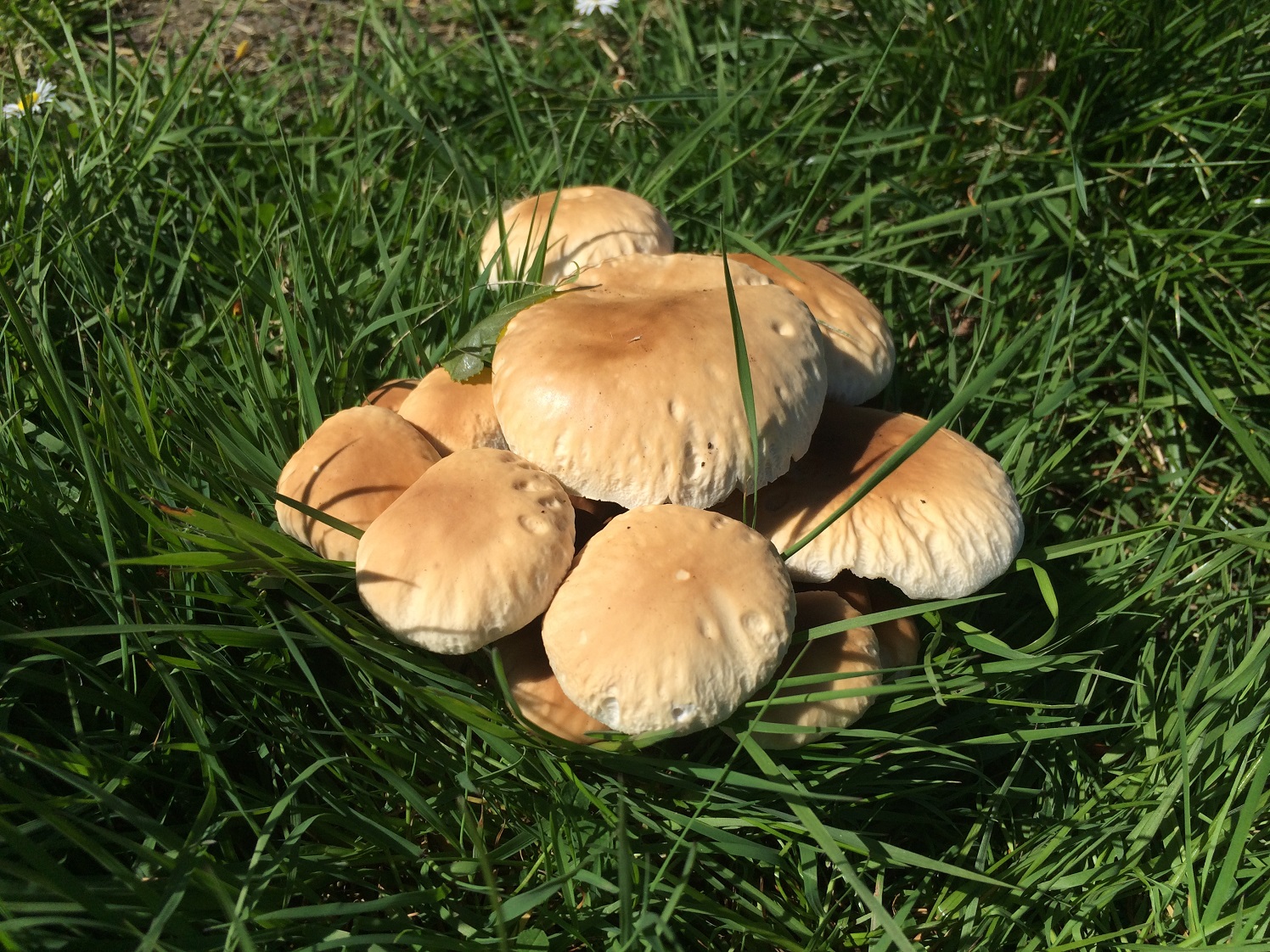
Agrocybe aegerita, commonly known as the poplar fieldcap, is an edible mushroom that grows on trees, especially poplars. It is appreciated for its flavor and texture, making it a popular choice among mushroom enthusiasts.
How to Identify
- Cap
- The cap of the poplar fieldcap ranges from 3 to 10 cm in diameter. It is typically convex when young, becoming flattened with age. The color varies from creamy white to light brown, often with a slightly darker center. The surface is smooth and dry, and the margin may be slightly incurved when young.
- Gills
- The gills are adnate to slightly decurrent, meaning they are attached to the stem and may run slightly down it. They are crowded and initially white, turning grayish-brown to brown as the spores mature.
- Stem
- The stem is cylindrical, typically 4 to 10 cm long and 0.5 to 1.5 cm thick. It is usually white to pale brown and has a fibrous texture. A ring or annulus is present on the upper part of the stem, which may be fragile and disappear with age.
- Flesh
- The flesh of Agrocybe aegerita is firm and white. It does not change color when bruised or cut.
- Fruiting body
- The fruiting body of Agrocybe aegerita typically has a convex to flattened cap and a cylindrical stem. The overall appearance is that of a medium-sized mushroom with a pleasant aroma.
- Habitat
- Agrocybe aegerita grows on dead or living trees, particularly poplars (Populus species), willows (Salix species), and elms (Ulmus species). It is often found in clusters on the trunks or branches of these trees. It is a saprophytic fungus, meaning it obtains nutrients from decaying organic matter.
Key Facts
- Cap surfaces: Smooth, dry
- Growth Form: Clustered
- Spore Print: Brown
- Body color: White to light brown
- Odor: Pleasant
- Flesh bruises: No
- Height: 4-10 cm
- Cap Diameter: 3-10 cm
- Nutrient gathering: Saprophytic
Safe
SafeAgrocybe aegerita is generally considered safe to eat when properly identified. However, as with any wild mushroom, it is essential to be 100% certain of the identification before consumption to avoid the risk of poisoning from similar-looking toxic species.
Quick Check
- Odor: Pleasant, mushroomy
- Fruiting: Grows on wood
- Substrate: Poplar, willow, elm
Where to Find
Europe
Agrocybe aegerita is native to Europe and is commonly found in many European countries.
North America
It has also been introduced to North America, where it can be found in regions with suitable host trees.
Asia
The mushroom is also found in some parts of Asia.
Finding Tips
Look for Host Trees
Focus your search on areas with poplar, willow, or elm trees, as these are the primary hosts for Agrocybe aegerita.
Check Tree Trunks and Branches
Examine the trunks and branches of these trees for clusters of mushrooms, especially after periods of rain.
Search in Autumn
The best time to find Agrocybe aegerita is typically in the autumn months when temperatures are cooler and moisture levels are higher.
Similar Species
Pholiota populnea
Mushroom
Also known as: Poplar Pholiota
Scientific Classification
- Phylum
- Basidiomycota
- Class
- Agaricomycetes
- Order
- Agaricales
- Family
- Strophariaceae
- Genus
- Agrocybe
Storage Information
- Max Temperature: 4
- Freezing duration: 3
- Min Temperature: 2
- Refrigeration: 5
How to Clean
To clean Agrocybe aegerita, gently brush off any dirt or debris from the cap and stem. Avoid washing them unless necessary, as they can absorb water and become soggy. If washing is required, do so quickly and pat them dry with a paper towel.
Explore Poplar Fieldcap
Identify mushrooms anywhere
Free on iOS, Android, and Web. Photo identification, full database, and your personal collection.