
Got a photo? Identify mushrooms instantly with the Mushby app
Open the appDescription
Agaricus bitorquis is a robust, edible mushroom of the Agaricaceae family known for its ability to push through asphalt and hard-packed soil. It is distinguished by its double ring on the stalk and its preference for highly compacted, nutrient-rich urban soils.
How to Identify
- Cap
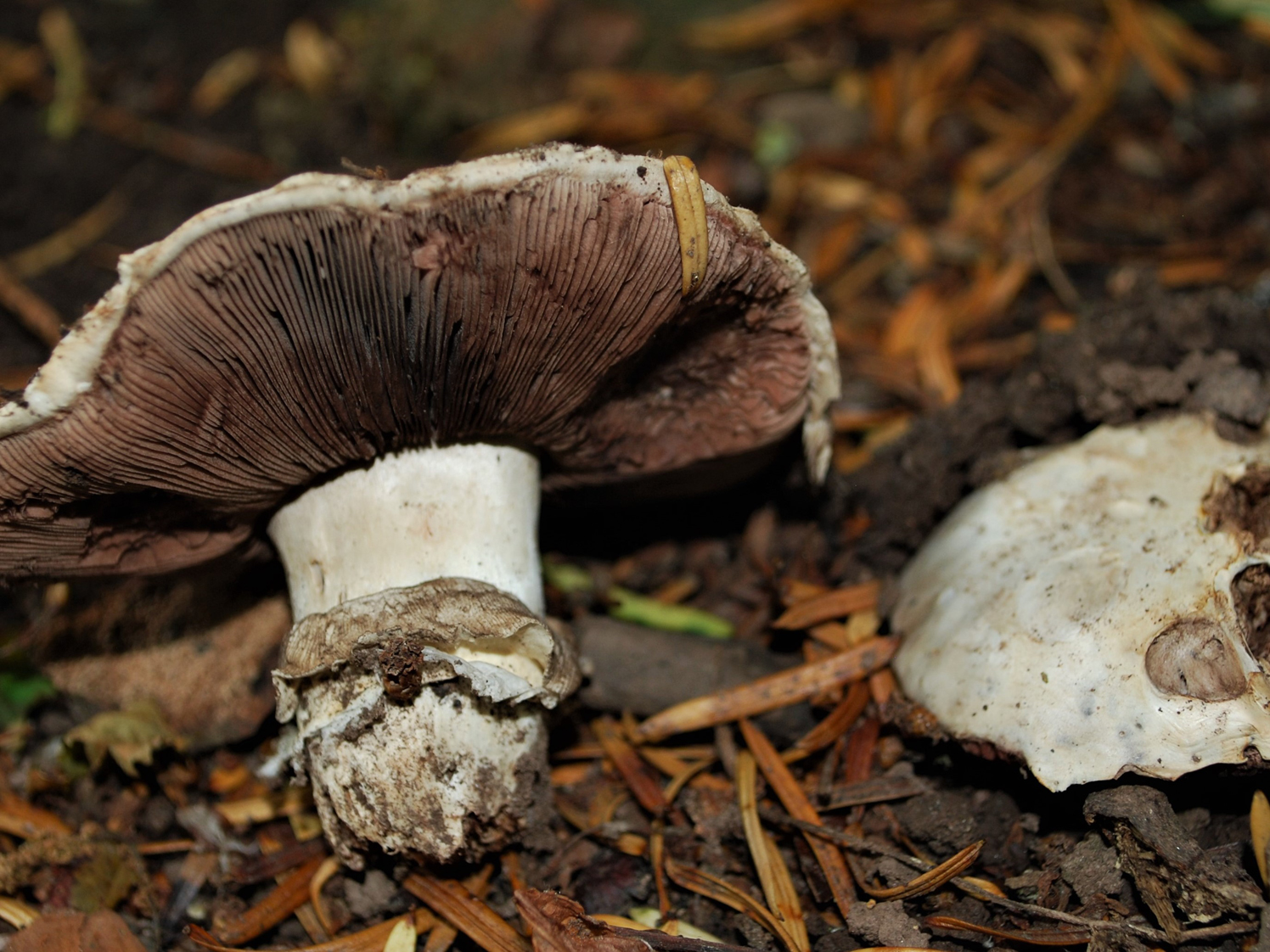
- Convex to flat, 5-15 cm, white to cream-colored, often with soil particles attached due to its subterranean development.
- Gills
- Free from the stem, initially pinkish, turning chocolate-brown with age.
- Stem
- Short and thick (relative to cap size), featuring a prominent double ring (annulus) derived from the partial veil.
- Flesh
- White, thick, firm, and does not show significant yellowing when bruised compared to poisonous look-alikes.
- Fruiting body
- Stocky and thick-fleshed mushroom with a firm texture.
- Habitat
- Commonly found in disturbed urban soils, sidewalks, compacted lawns, and roadsides.
Key Facts
- Cap surfaces: Smooth to slightly scaly, white.
- Growth Form: Solitary or small groups.
- Spore Print: Chocolate brown.
- Body color: White.
- Odor: Faintly almond-like or characteristic mushroom scent.
- Flesh bruises: Does not stain yellow.
- Height: 5-10 cm.
- Cap Diameter: 5-15 cm.
- Nutrient gathering: Saprobic.
Safe
SafeEdible and choice, but caution is advised to ensure accurate identification to avoid confusion with poisonous Agaricus species that stain yellow (e.g., A. xanthodermus).
Quick Check
- Odor: Pleasant, mild, mushroomy aroma.
- Fruiting: Often gregarious or in small troops, occasionally solitary.
- Substrate: Compacted soil, gravel, and asphalt-covered ground.
Where to Find
Urban Environments
Found erupting through pavement, asphalt, or heavily trodden paths.
Compacted Soils
Common in gardens, parks, and around tree bases where soil has been firmly compressed.
Finding Tips
Look for Bumps
Since this mushroom is powerful enough to break asphalt, look for small cracks or mounds in pavement where the mushroom is pushing through.
Seasonality
Often appears earlier in the spring than other Agaricus species, sometimes starting in late spring through autumn.
Similar Species
Yellow Stainer
Agaricus xanthodermus
Also known as: Agaricus xanthodermus
Field Mushroom
Agaricus campestris
Also known as: Field Agaricus
Scientific Classification
- Phylum
- Basidiomycota
- Class
- Agaricomycetes
- Order
- Agaricales
- Family
- Agaricaceae
- Genus
- Agaricus
Storage Information
- Max Temperature: 4 degrees Celsius
- Freezing duration: Not recommended to freeze fresh
- Min Temperature: 1 degree Celsius
- Refrigeration: Up to 3-5 days in a paper bag
How to Clean
Use a soft brush to remove dirt, trim the base of the stem to remove any embedded soil or debris, and wipe with a damp cloth; avoid heavy soaking.
Explore Garden Agaricus, Pavement Mushroom
Identify mushrooms anywhere
Free on iOS, Android, and Web. Photo identification, full database, and your personal collection.